

Listen to summary
Olive oil fraud is a real problem. In fact, several independent studies have found that a meaningful share of oils labeled “extra virgin” on supermarket shelves fail to meet the full standard. Often, this comes from poor storage or simple aging, not always outright fraud. Either way, you could be paying a premium price for an oil that isn’t what the label promises. So how do you actually spot real, high-quality olive oil?
This guide walks through every real quality marker, step by step. We will also show how production choices affect quality. And, along the way, we will show where Iline Organic fits in, since it presses and bottles its own organic oil straight from its groves in Tunisia
1. What Defines High-Quality Olive Oil?
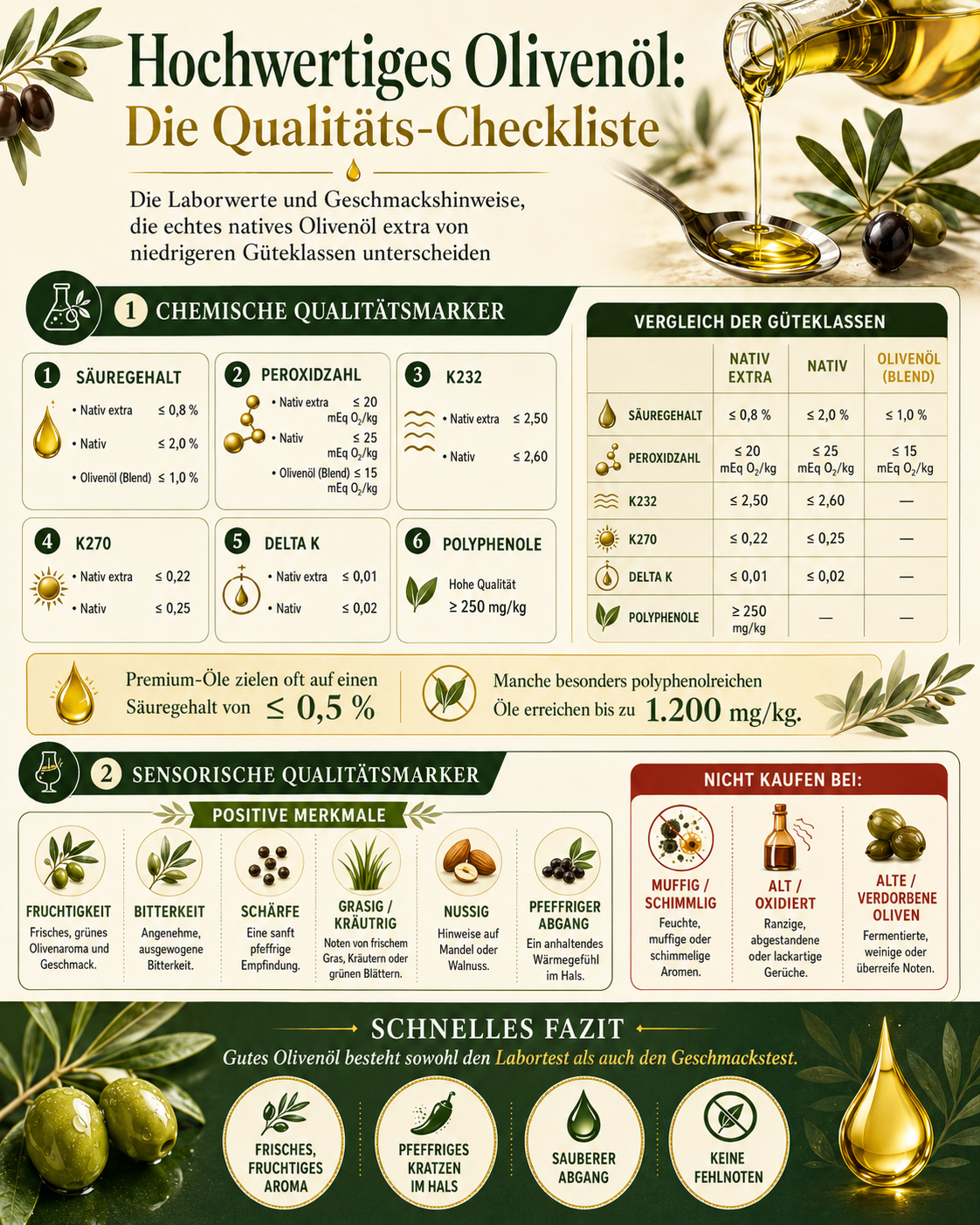
High-quality olive oil, and Extra Virgin Olive Oil in particular, must pass strict chemical and sensory checks. These checks come from the International Olive Council’s trade standard, which the EU and most producing countries follow.
1.1 Chemical Quality Markers
| Marker | Extra Virgin | Virgin | Olive Oil (Blended) |
| Acidity | At or below 0.8% | At or below 2.0% | At or below 1.0% |
| Peroxide value | At or below 20 mEq O₂/kg | At or below 25 mEq O₂/kg | At or below 15 mEq O₂/kg |
| K232 | At or below 2.50 | At or below 2.60 | — |
| K270 | At or below 0.22 | At or below 0.25 | — |
| Delta K | At or below 0.01 | At or below 0.02 | — |
| Polyphenols | High (250 mg/kg or more) | Medium | Low |
So, in short, four main lab tests reveal true quality:
- Free acidity, the primary marker
- Peroxide value, which shows oxidation
- K232, K270, and Delta K, which also track oxidation
- Total polyphenols, the oil’s natural antioxidants
For context, Iline Organic’s Polyphena can reach up to 1,200 mg/kg of polyphenols. That is, in fact, well above the 250 mg/kg threshold the EU uses for its health claims
1.2 Sensory Quality Markers
Under IOC rules, every extra virgin olive oil must show three positive attributes: fruitiness, bitterness, and pungency. An oil missing even one of these technically fails the extra virgin standard. Beyond these three, a genuinely good oil should carry no off-notes. Trained tasters reject any oil that tastes:
- Musty or moldy
- Stale, as if oxidized or old
- Like old, spoiled olives
On the other hand, a genuinely good oil shows positive traits, such as:
- Nutty
- Fruity (green or yellow)
- Peppery, a burning sensation at the back of the throat
2. What Affects Quality During Production
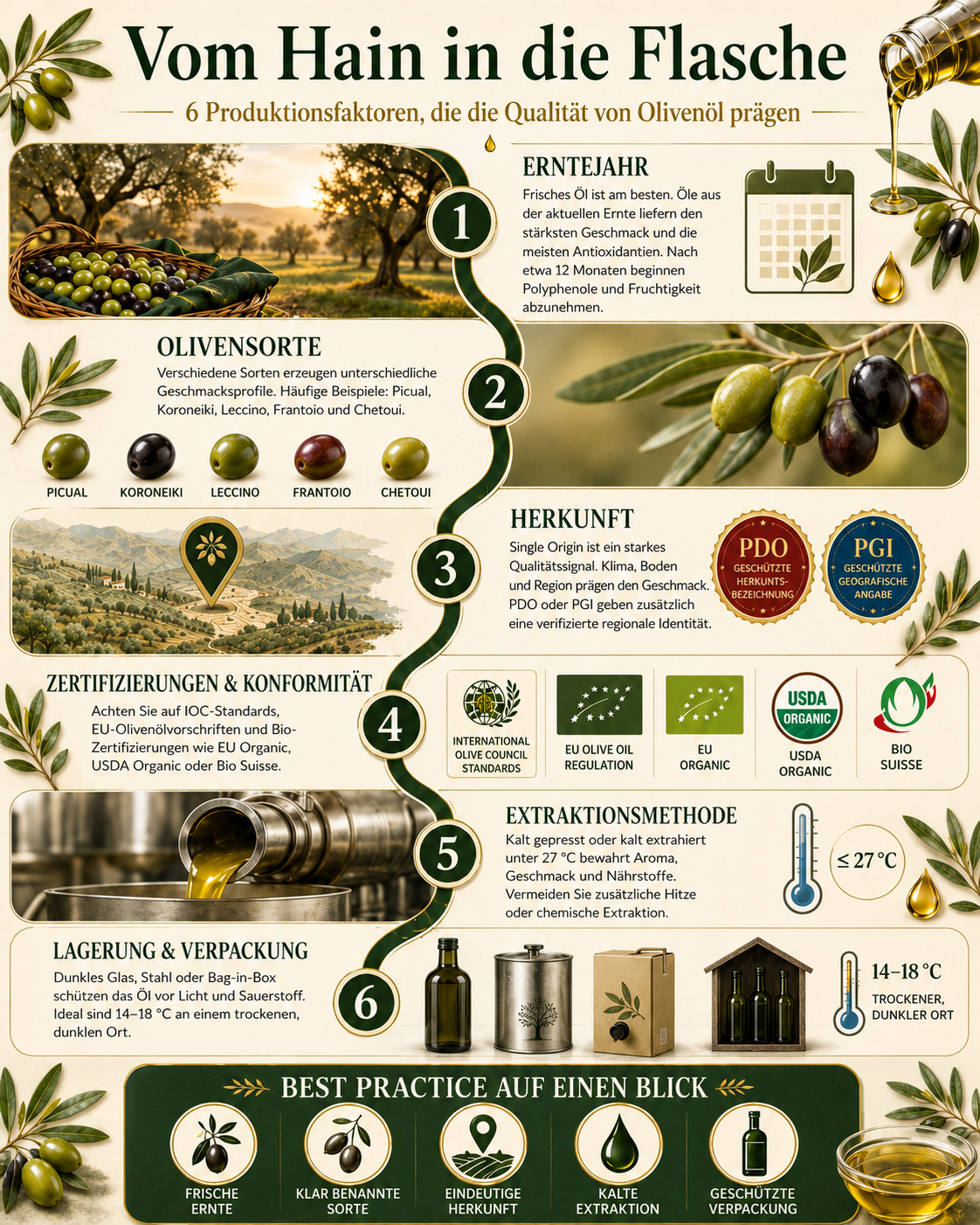
2.1 Harvest Year
High-quality olive oil is a fresh product above all else. The best oils come from the current harvest year, and after about 12 months an oil loses a meaningful share of its polyphenols. When a producer lists the harvest year, that is the clearest freshness signal. If only a best before date is shown, look for one that is no more than 12 to 18 months away from the date of purchase — anything longer suggests the oil may already be well past its peak.
2.2 Olive Variety
Different olive varieties, in fact, produce noticeably different oils. Premium producers, therefore, name the variety right on the label. Common examples include Picual, Koroneiki, Leccino, and Frantoio. Iline Organic’s Dalia, for instance, is pressed from Chetoui olives, a variety grown across Tunisia and prized for its intensity
2.3 Country and Region of Origin
Spain, Italy, Greece, Tunisia, and Turkey all produce excellent oil. Coastal climate and soil quality, however, both shape the final taste. So look for protection labels like PDO (Protected Designation of Origin) or PGI, since these guarantee a true regional source. Iline Organic, for example, sources its olives from its own groves in Tunisia, rather than from a mix of countries. A clear single origin is one of the strongest signs of high-quality olive oil.
2.4 Certifications and Compliance
Genuine Extra Virgin oil must meet International Olive Council standards. It must also meet EU regulations for olive oil quality. Iline Organic, in addition, holds EU Organic, USDA Organic, and Bio Suisse certification on top of those baseline rules.
2.5 Extraction Method
Cold pressing, under 27°C, is the foundation of high-quality olive oil. This means mechanical extraction only, without heat or added chemicals. So watch out for “centrifuga” processes that rely on extra heat to squeeze out more oil, since that heat strips away aroma and nutrients.
2.6 Storage and Packaging
Dark glass bottles or steel canisters, above all, protect oil from light. Plastic bottles, by contrast, let in oxygen and speed up spoilage. Ideal storage, therefore, sits between 14 and 18°C, in a dry, dark spot. Iline Organic ships its oils in dark glass, bag-in-box, or steel formats for exactly this reason. Its warehouses are also temperature-controlled and maintained within that same 14–18°C window, so the oil stays protected from production all the way to your door.
3. How to Identify Real vs. Low-Quality Olive Oil
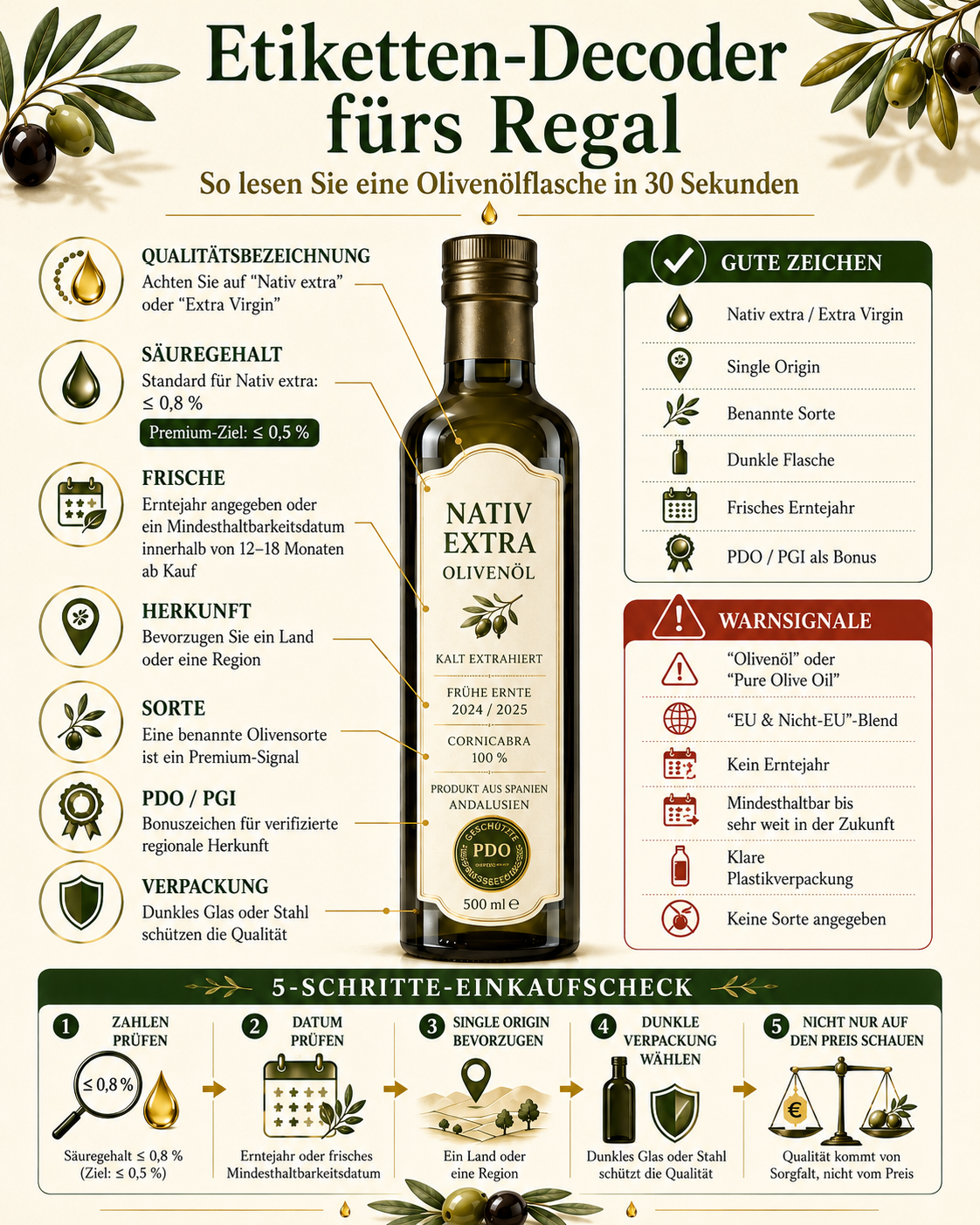
3.1 Check the Label
| What to look for | High quality | Low quality |
| Quality name | “Extra Virgin” / “Nativ Extra” | “Olive Oil,” “Pure Olive Oil” |
| Acidity | At or below 0.8% (often under 0.5%) | Above 0.8% (fails Extra Virgin standard by regulation) |
| Harvest year | A specific year listed | Best before date over 18 months away, or no date at all |
| Origin | One country or region | Blended (“EU & Non-EU”) |
| Variety | Olive variety named | No indication |
| PDO / PGI (bonus signal, not required) | Sometimes present — adds verified regional guarantee | Rarely present |
| Packaging | Dark glass or steel | Plastic, clear bottle |
3.2 Key Label Clues
- Free acidity, the primary marker
- Peroxide value, which shows oxidation
- K232, K270, and Delta K, which also track oxidation
- Total polyphenols, the oil’s natural antioxidants
Together, these clues make it easy to recognize high-quality olive oil at a glance.
3.3 Shopping Checklist
So, before you buy, run through this short list:
- Look past the price tag, and check the actual numbers first
- Check acidity, and aim for 0.5% or lower in a premium oil
- Check the best before date : avoid oils with a date more than 18 months away, since that often signals a very old harvest
- Prefer single origin, and skip “EU & Non-EU” blends
- Choose a dark bottle, since light speeds up oxidation
4. Practical Ways to Judge Quality Yourself
Beyond the label, a few simple checks help confirm high-quality olive oil before you commit to a bottle.
4.1 The Fridge Test, and Why It Falls Short
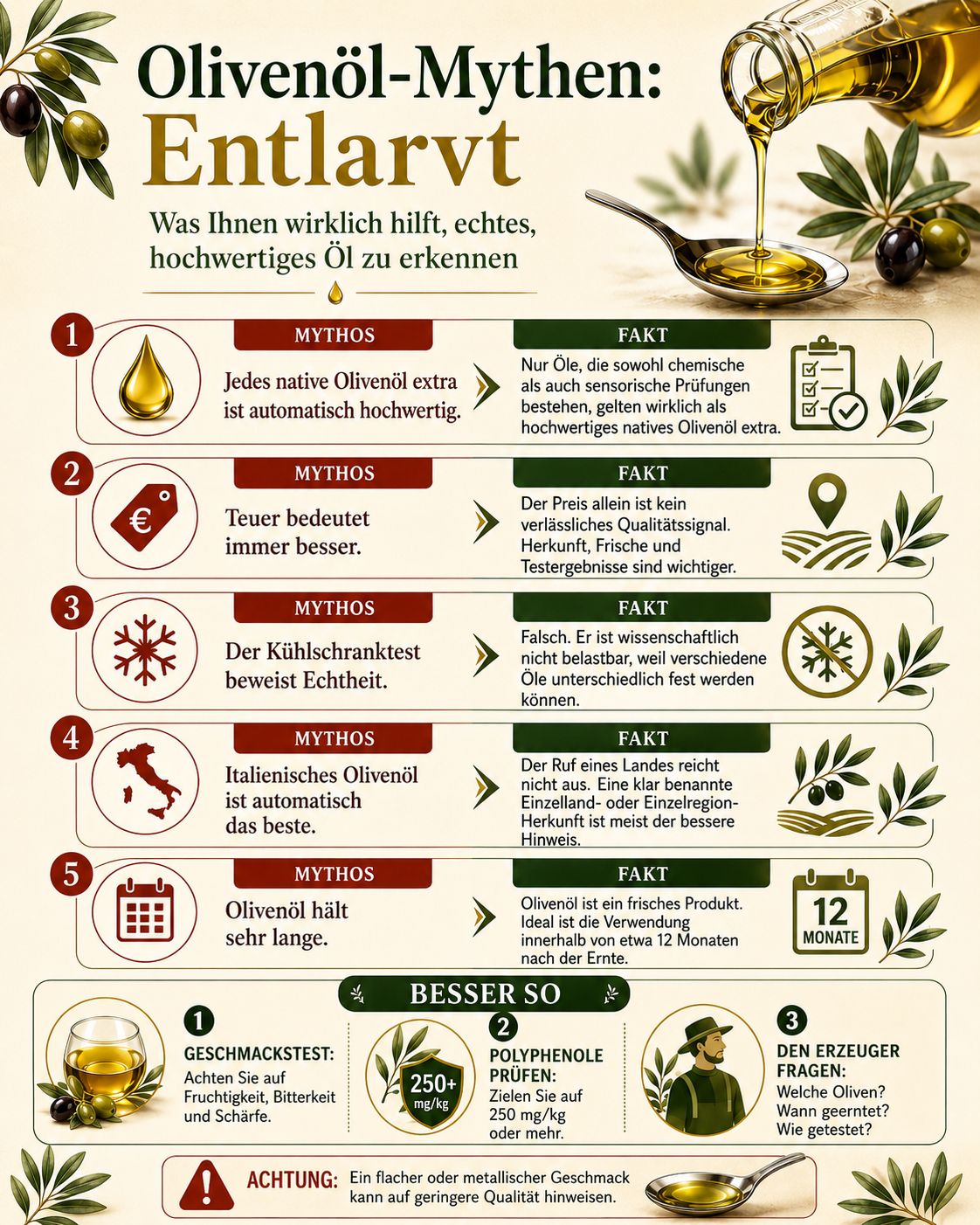
This popular trick is simple. You place the oil in the fridge for about 24 hours, at roughly 4°C. Real olive oil, the theory goes, turns firm or creamy, thanks to its monounsaturated fats. Adulterated oil, in theory, stays liquid. However, this test is not scientifically valid, since both real and altered oils can behave either way depending on their exact fat profile. So treat it as a curiosity, not real proof.
4.2 A Simple Taste Test
Instead, try a small sip on its own. Every genuine extra virgin olive oil must show three positive attributes: fruitiness, bitterness, and pungency. If any one of these is absent, the oil technically does not qualify as extra virgin. A peppery burn at the back of the throat signals pungency and high polyphenols, both signs of real quality. A flat or even metallic taste, on the other hand, often points to a lower-grade oil.
4.3 Check the Polyphenol Count
Premium oils, above all, state their polyphenol content right on the label. Aim for 250 mg/kg or more, since that is the EU’s own benchmark. Polyphenols, after all, are the anti-inflammatory antioxidants that give good oil its peppery bite.
4.4 What to Ask a Producer
Finally, a producer of high-quality olive oil should answer three questions without hesitation: which olives, picked when, and tested how. Iline Organic publishes its harvest windows, olive variety, and certifications for each product line — visit the Grove page to see exactly where and how its olives are grown — so none of that has to be taken on faith.
5. Common Olive Oil Myths, Debunked
5.1 Myths About Authenticity and Price
1. All oils labeled Extra Virgin are high-quality. False.
As covered above, a real share of “extra virgin” labeled oils fail to meet the full standard. Only oils that pass both the chemical and sensory tests, therefore, are genuinely high-quality olive oil.
2. Expensive olive oil always means high-quality olive oil. False, too.
Price, in fact, is not a reliable quality signal. Many lower-priced oils from Greece or Tunisia outperform expensive blended oils from elsewhere. So a clear single origin, like Iline Organic’s Tunisian groves, matters more than the price tag.
3. The fridge test proves real olive oil. False, as we covered above.
This test has never been scientifically validated. Only lab tests, such as acidity, peroxide value, and K232/K270, actually prove quality.
5.2 Myths About Origin and Storage
1. Italian olive oil is automatically better. False.
In fact, many Italian-labeled oils are blends sourced from several countries. A single, named origin, such as Greece, Spain, or Tunisia, is usually the stronger signal of quality.
2. Olive oil can be stored for a long time. False.
Olive oil is, above all, a fresh product. After about 12 months, in fact, it loses a real share of its polyphenols and fruitiness. That is exactly why the harvest date matters so much.
6. Conclusion: How to Choose the Right Olive Oil
So, to sum up, finding real, high-quality olive oil comes down to a short list:
- Choose “Extra Virgin” or “Nativ extra,” and nothing less
- Prefer acidity at or below 0.5% for a premium oil
- Look for a best before date within 12–18 months — fresher is always better
- Choose a single origin over a blend
- Prefer a named olive variety
- Use dark glass or a steel canister
- Look for 250 mg/kg of polyphenols or more
With these checks, you protect yourself from fraud. And, just as importantly, you end up with high-quality olive oil that has real flavor and real health benefits. If you would rather skip the detective work, Iline Organic presses its full range, from the mild Hana to the high-polyphenol Polyphena, directly from its own Tunisian groves. Every batch, moreover, carries EU Organic, USDA Organic, Bio Suisse, FSSC 22000, and BRCGS certification, so you can verify it yourself rather than take a label’s word for it.
7. FAQ — Frequently Asked Questions About Olive Oil Quality
1. What is the ideal acidity for high-quality olive oil? The standard for Extra Virgin Olive Oil is at or below 0.8%. For a premium oil, however, aim for 0.5% or lower.
2. How do I spot high-quality olive oil on the label? Look for “Extra Virgin” or “Nativ extra,” a stated acidity, a harvest year or a best before date within 12–18 months, a single origin, a named olive variety, and dark packaging. A PDO or PGI mark is a useful bonus but not a requirement for high quality.
3. What are polyphenols in olive oil, and why do they matter? Polyphenols are natural antioxidants with anti-inflammatory properties. High-quality oils, therefore, carry 250 mg/kg or more.
4. Is the fridge test reliable for spotting real olive oil? No, it is not scientifically validated. Only lab tests, such as acidity, peroxide value, and K232/K270, actually prove quality.
5. How long should I keep a bottle of olive oil? Olive oil is a fresh product, so use it within 12 months of harvest. After that point, it loses a real share of its polyphenols and fruitiness.
6. Why is olive oil fraud so common? Because genuine Extra Virgin oil is costly to produce, while ordinary oil is cheap, the gap between the two creates an incentive for fraud. Several independent studies, as a result, have flagged a meaningful share of “extra virgin” labeled oils for failing to meet the full standard.
7. Which regions produce the highest-quality olive oil? Strong regions include Andalusia in Spain, Tuscany in Italy, and the Tunisian coast. In every case, single origin beats a blend.
8. Can a cheaper olive oil still be high-quality? Yes. Many lower-priced oils from Greece or Tunisia, in fact, outperform pricier blended oils. So price alone is not a reliable quality signal.

Downloads
Video summary