

Listen to summary
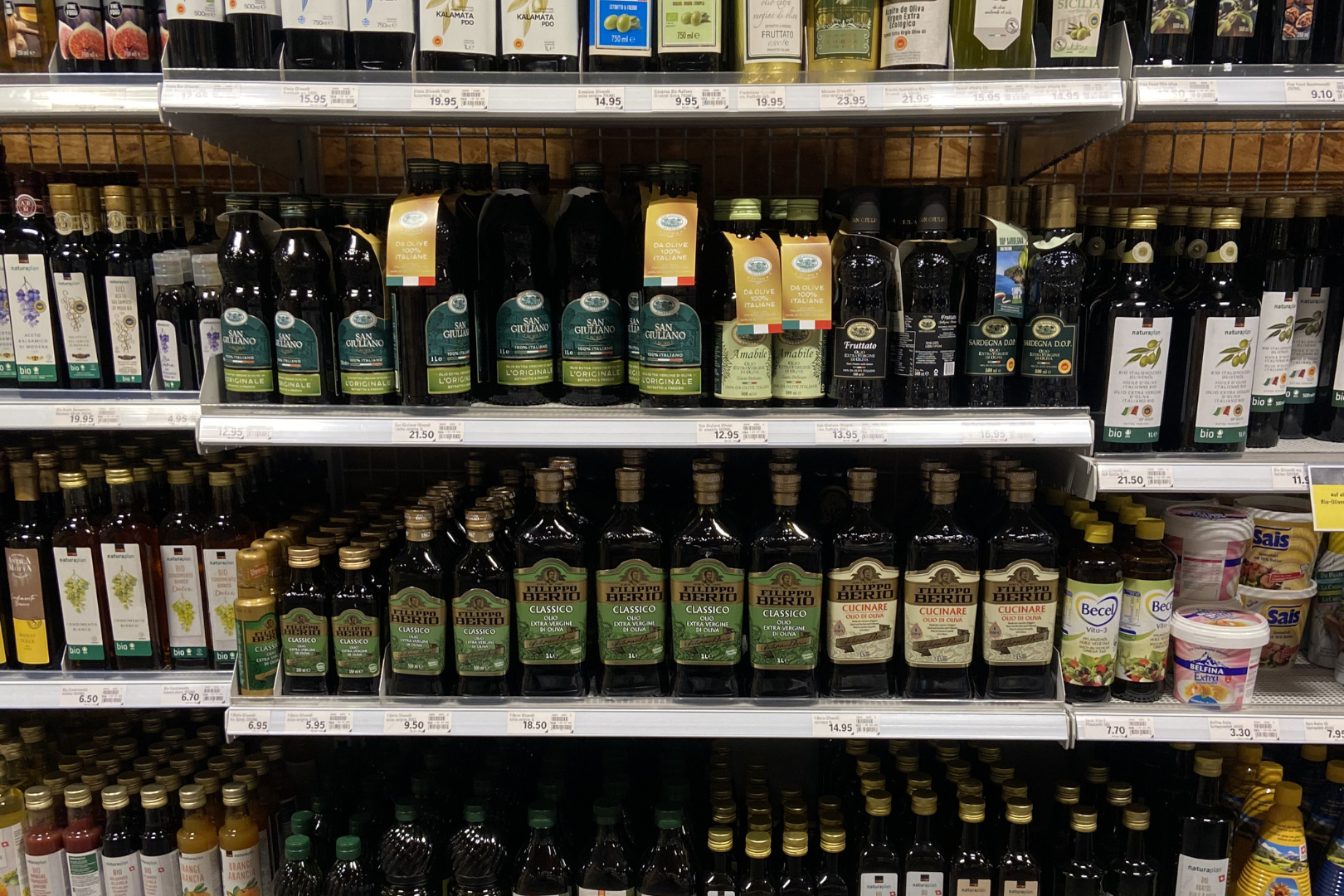
A good extra virgin olive oil combines flavor, health benefits, and craftsmanship in a single bottle. Yet many products labeled “Extra Virgin” on supermarket shelves fail to live up to that promise. In a comprehensive independent laboratory study of 183 olive oils sold in Swiss supermarkets, only around one in five oils (21.3%) actually met the legal requirements for the highest quality grade. The majority were downgraded, with some even classified as “not suitable for sale to consumers.”
In this article, you will see retailer-by-retailer results—from Migros and Coop to Aldi and Lidl—including how many oils passed and which products performed well. At the end, you will find a free downloadable Excel file containing all 183 tested oils, along with a practical buying guide to help you choose a quality olive oil on your next shopping trip.
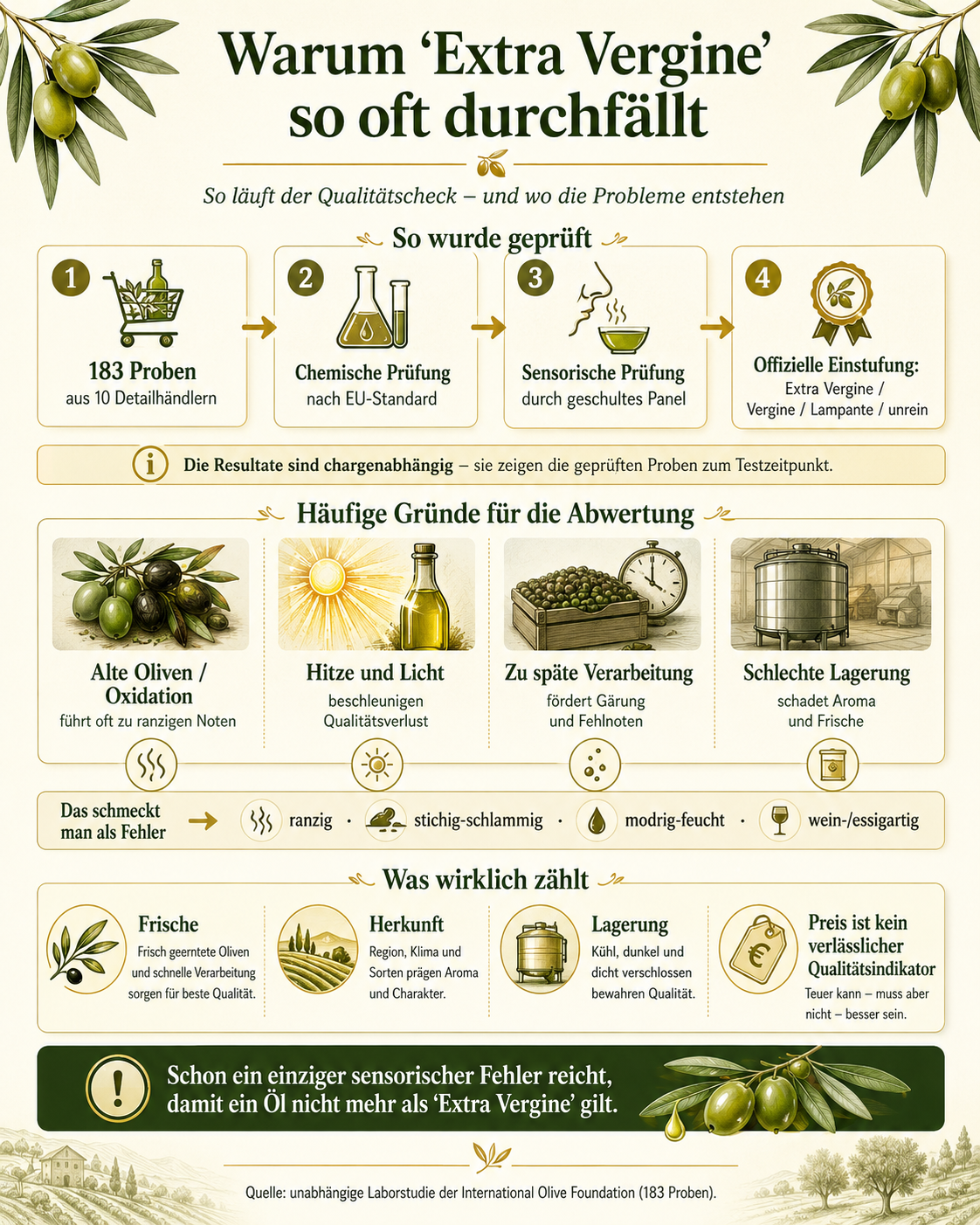
1. Key Takeaways
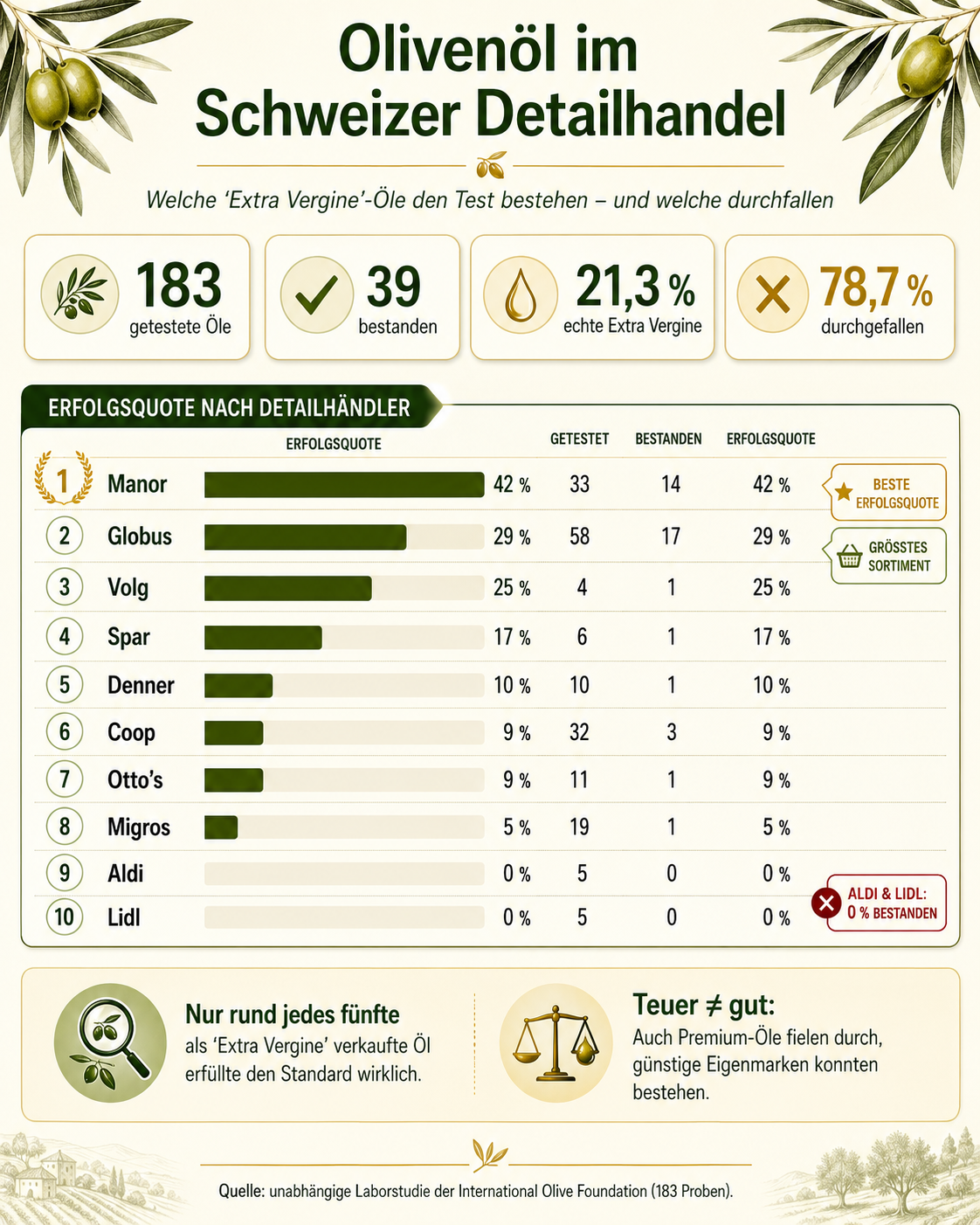
- Only 39 out of 183 oils sold as “Extra Virgin” truly met the standard—78.7% failed.
- Manor achieved the best results (42% passed), while Aldi and Lidl had the weakest performance (0% of tested oils passed).
- Expensive does not necessarily mean better. Several premium oils failed, while affordable store brands (e.g., Migros Bio and Volg) passed.
- The most common defects were rancid, muddy/fusty, and musty flavors—typically signs of old olives, heat exposure, or poor storage.
- A complete Excel list of all 183 oils is available free of charge (overview plus individual worksheets for each retailer)—see the download section below.
2. What Does “Extra Virgin” Actually Mean?
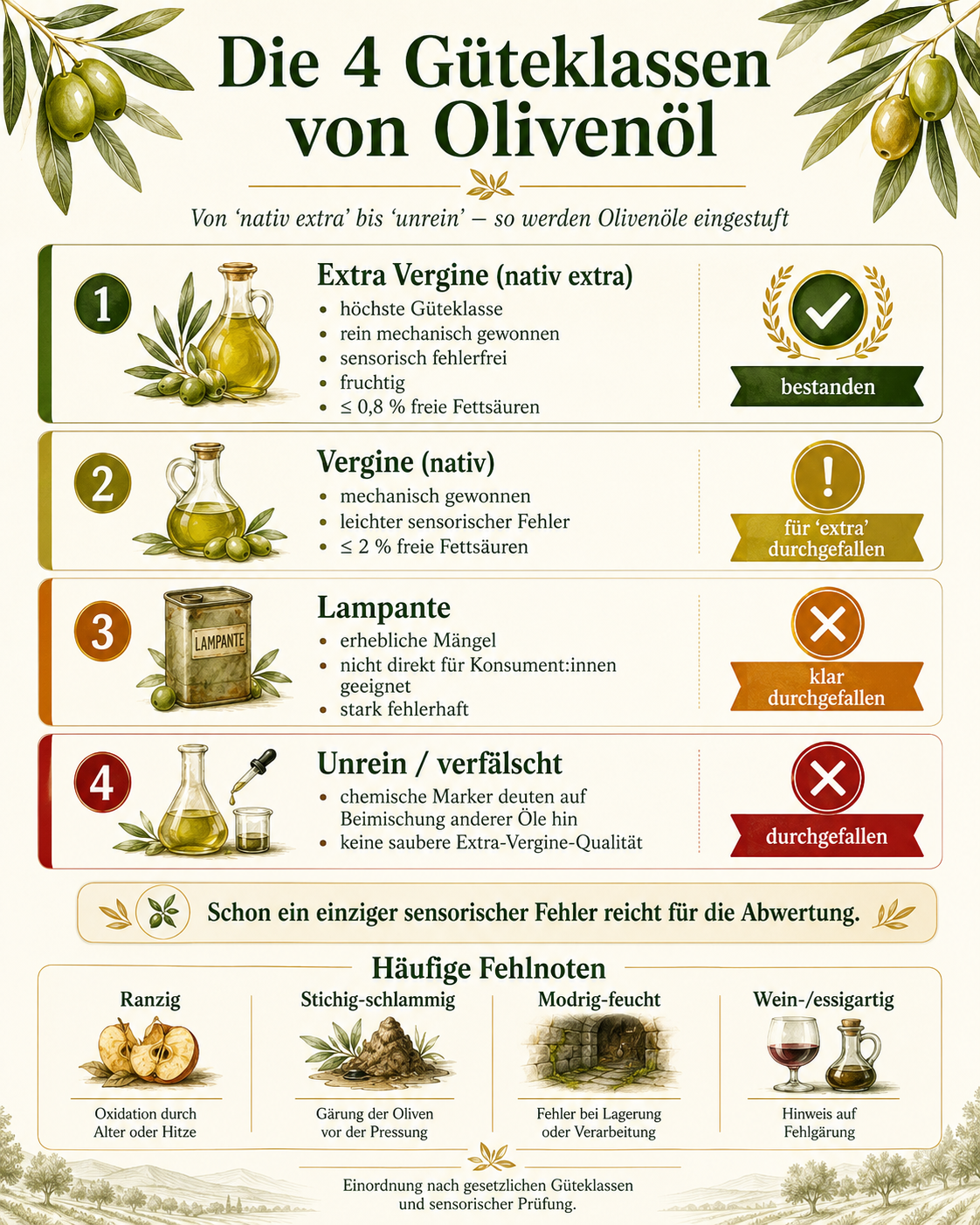
“Extra Virgin Olive Oil” is the highest of four official quality grades. It is extracted solely through mechanical processes, must be free from sensory defects, and may contain no more than 0.8% free fatty acids. These requirements are legally defined in both Switzerland and the European Union under Regulations (EU) 2022/2104 and 2022/2105, which replaced the former Regulation 2568/91.
2.1 The Four Quality Grades Explained
- Extra Virgin Olive Oil: Highest quality, no defects, fruity flavor. → Passed
- Virgin Olive Oil: Mechanically extracted but contains minor sensory defects; up to 2% acidity. → Failed (for “extra virgin” classification)
- Lampante Olive Oil: Significant defects; cannot be sold directly to consumers. → Failed
- Adulterated/Impure Oil: Chemical markers indicate mixing with other oils. → Failed
2.2 Why Do So Many Oils Fail?
A trained sensory panel looks for common defects such as rancidity (oxidation caused by age or heat), fusty/muddy flavors (fermentation before pressing), musty notes, and winey-vinegary characteristics. Even a single defect is enough to lose the “extra virgin” classification.
Learn more about aromas, polyphenols, and professional tasting methods in our Olive Oil Quality & Tasting Guide.
3. How This Data Was Collected (Transparency)
This analysis is based on an independent laboratory study conducted by the International Olive Foundation (IOF). The study evaluated 183 olive oils labeled as “Extra Virgin” from ten Swiss retailers using both chemical and sensory testing according to EU standards. Each oil received an official classification (Extra Virgin, Virgin, Lampante, or Impure).
It is important to note that olive oil quality can vary between batches depending on harvest conditions, bottling dates, and storage time. These results describe the specific samples tested at the time of the study, not necessarily every bottle currently on store shelves. However, they reveal a structural pattern that has been documented for years by international authorities, including the EU’s Oleum Project and the International Olive Council: “Extra Virgin” remains one of the most frequently adulterated food categories worldwide.
4. Olive Oil Quality by Swiss Retailer: Overview
| Retailer | Tested | Passed | Success Rate |
| Manor | 33 | 14 | 42% |
| Globus | 58 | 17 | 29% |
| Volg | 4 | 1 | 25% |
| Spar | 6 | 1 | 17% |
| Denner | 10 | 1 | 10% |
| Coop | 32 | 3 | 9% |
| Otto’s | 11 | 1 | 9% |
| Migros | 19 | 1 | 5% |
| Aldi | 5 | 0 | 0% |
| Lidl | 5 | 0 | 0% |
Free Download: The complete list of all 183 olive oils—including pass/fail status, origin, price, and bottler, plus a dedicated worksheet for each retailer—is available as an Excel file:
5. Olive Oil at Manor: The Top Performer
Manor achieved the highest success rate, with 14 out of 33 oils passing (42%)—more than double the market average. Standout products included the Italian Azienda Agraria Viola “Inprivio” and a Spanish DOP Montes Toledo (Cornicabra) olive oil offered at a fair price. However, approximately half of the assortment was still downgraded, with some products classified as Lampante. Look for DOP/IGP certifications and harvest dates whenever possible. Compare flavor profiles in our Olive Oil Comparison Guide.
6. Olive Oil at Globus: Large Selection, Mixed Results
Globus offered the largest assortment with 58 tested oils and 17 successful results (29%). Several high-quality Spanish oils stood out, including Cortijo de Suerte Alta, Omed Picual, and Valroble. At the same time, Globus was the only retailer where the study identified products classified as “impure.” The retailer demonstrates that even a premium-looking label is not a guarantee of quality.
7. Olive Oil at Volg: Small Selection, Solid Store Brand
Volg carried only four tested oils, one of which passed (25%). Notably, the successful product was Volg’s own store brand olive oil from Spain, priced at approximately CHF 9.50. It is a strong example that an affordable private-label oil can still qualify as genuine extra virgin olive oil.
8. Olive Oil at Spar: One Successful Product
At Spar, one out of six oils passed (17%)—a Bertolli Originale blend sourced from EU countries and priced at around CHF 7.50. Spar’s own store-brand olive oil was downgraded to Lampante. Consumers should focus on oils with clearly stated origins and harvest dates.
9. Olive Oil at Denner: Limited Range, Weak Results
Denner achieved just one passing result out of ten tested oils (10%). Several well-known brands were classified as Virgin or Lampante. The only successful product was another Bertolli Originale olive oil. Brand recognition alone is not a reliable indicator of quality—freshness and origin matter far more.
10. Olive Oil at Coop: Wide Choice, Few Winners
Coop tested 32 olive oils, but only three passed (9%). The successful products included outstanding oils with protected origins, such as Sapori d’Italia Sicilia IGP, the Demeter-certified Son Naava DOP Mallorca, and Rincón de la Subbética DOP Priego de Córdoba. Several Coop private-label products, including Qualité & Prix and Naturaplan, were classified only as Virgin olive oils.
Related: Which Olive Oil Pairs Best with Which Dish?
11. Olive Oil at Otto’s: One Bright Spot
At Otto’s, one out of eleven oils passed (9%)—a Monini Originale product from its foodservice range. Half of the remaining assortment was classified as Lampante. Affordable prices are not necessarily accompanied by genuine extra virgin quality.
12. Olive Oil at Migros: Organic Store Brand Leads the Way
Migros tested 19 oils, with only one passing result (5%). Interestingly, the successful product was the “Migros Bio Spanish Extra Virgin Olive Oil,” priced at approximately CHF 9.20. This supports the idea that organic private-label oils can be among the more reliable supermarket options, while several more expensive branded products were downgraded.
13. Olive Oil at Aldi: No Oil Passed
None of the five Aldi oils tested achieved Extra Virgin classification (0%). Most were downgraded to Virgin olive oil, while one Greek PDO olive oil was classified as Lampante. This does not necessarily mean the oils are unsuitable for cooking, but the “Extra Virgin” claim did not hold up under testing.
14. Olive Oil at Lidl: Also No Successful Results
Lidl likewise had no passing products among the five oils tested (0%). The retailer’s Primadonna private-label oils were particularly affected, with some receiving Lampante ratings. Discount olive oils may be acceptable for everyday use, but they are not a substitute for fresh, traceable extra virgin olive oil.
15. How to Identify a Good Olive Oil When Shopping
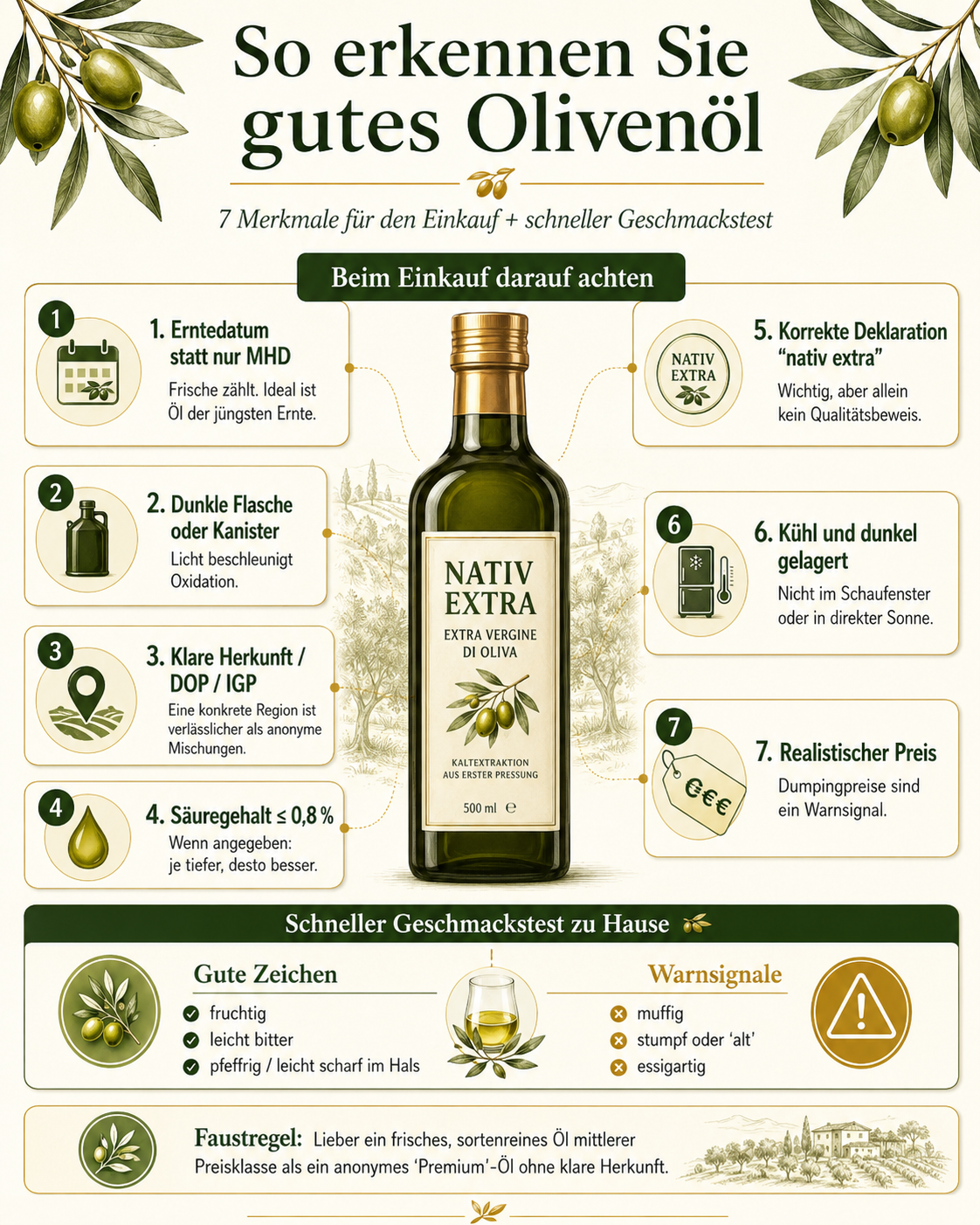
You do not need a laboratory to avoid poor-quality olive oil. These indicators can help immediately:
15.1 7 Signs of a Good Olive Oil
- Look for a harvest date, not just a best-before date. Freshness matters.
- Choose dark bottles or metal tins. Light accelerates oxidation and rancidity.
- Look for a specific region of origin. DOP/IGP certifications are generally more reliable than “blend of EU countries.”
- If listed, acidity should be 0.8% or lower—the lower, the better.
- Ensure it is labeled “Extra Virgin,” but remember that labeling alone is not proof of quality.
- Check whether the oil is stored away from sunlight and heat in the store.
- Be realistic about pricing. Genuine extra virgin olive oil has a minimum production cost, and extremely cheap products should raise concerns.
15.2 A Simple Home Taste Test
Good olive oil tastes fruity, slightly bitter, and may create a peppery sensation in the back of the throat. This pepperiness indicates the presence of fresh polyphenols. If the oil tastes stale, musty, flat, or vinegary, it likely contains sensory defects.
16. Is Expensive Olive Oil Worth It?
The data provides a clear answer: price is not a reliable indicator of quality. Several affordable store-brand oils passed the test, including Migros Bio (approximately CHF 9.20) and Volg’s private label (approximately CHF 9.50), while numerous premium-priced oils failed.
The key factors are freshness, origin, and storage conditions—not the price tag. As a rule of thumb, choose a fresh, single-origin olive oil with a harvest date rather than an anonymous “premium” oil without traceable origins.
Still unsure? Our “Which Olive Oil Is Right for Me?” Finder can help.
17. The Reliable Alternative: Fresh Olive Oil with Clear Origin
If this supermarket study demonstrates one thing, it is that transparency matters more than labels. This is exactly where Iline Organic focuses its efforts—offering organic extra virgin olive oil with fully traceable origins, fresh harvests, and clearly defined flavor profiles, including mild, balanced, and intense varieties, as well as oils rich in polyphenols and a Demeter-certified range.
Instead of guessing in the supermarket aisle, you know exactly what is in the bottle and where it comes from. Discover your ideal olive oil profile or learn why making the switch can make a difference.
18. Frequently Asked Questions (FAQ)
18.1 Which olive oil is best in Swiss supermarkets?
In the independent laboratory study, Manor achieved the best results, with 42% of tested oils passing, followed by Globus. However, quality ultimately depends on the individual product. Look for DOP/IGP certifications, harvest dates, and proper storage conditions.
18.2 Is supermarket “Extra Virgin” olive oil always genuine?
No. Of the 183 oils tested and labeled “Extra Virgin,” only 39 (21.3%) actually met the standard. The label alone is not a guarantee.
[H3] Why does an olive oil fail testing?
Most failures result from sensory defects such as rancid, muddy/fusty, or musty flavors. These issues often stem from old olives, heat exposure, oxidation, or poor storage. A single defect is enough to trigger a downgrade.
[H3] Is cheap olive oil automatically bad?
No. Several affordable organic private-label oils passed the study, while expensive branded products failed. Freshness and origin are more important than price.
18.3 How should olive oil be stored?
Store olive oil in a cool, dark place with the bottle tightly sealed. Keep it away from stoves and windows, and consume it within a few months of opening.
18.4 What is the difference between Extra Virgin, Virgin, and Lampante olive oil?
Extra Virgin olive oil is defect-free and contains no more than 0.8% acidity. Virgin olive oil may contain minor defects and up to 2% acidity. Lampante olive oil has significant defects and cannot be sold directly to consumers without refining.
19. Conclusion: Read Labels Carefully, Check Origins, Buy Fresh
This large-scale market study highlights a simple reality: many olive oils labeled “Extra Virgin” on Swiss supermarket shelves fail to meet the standard they claim. Only one in five products delivered what the label promised.
The good news is that understanding quality grades, origin certifications, harvest dates, and flavor characteristics enables you to make better buying decisions—regardless of where you shop.
Your next step: download the complete Excel list of all 183 tested olive oils and check your favorite brand—or switch to a fresh olive oil with transparent origins and verified quality.
About the Editorial Team: This article was produced in collaboration with the olive oil experts at Iline Organic, specialists in olive cultivation, quality assessment, and sensory evaluation of extra virgin olive oil. Learn more about us.

Video summary