

Listen to summary
More people are choosing to buy olive oil online than ever before. And it’s easy to see why. A crowded supermarket shelf rarely tells you when the oil was pressed. It also won’t tell you where the olives grew, or whether the bottle in your cart is even real extra virgin olive oil. When you buy olive oil online from a specialist shop, you also get far more detail than a small label could ever share — many producer sites, such as Iline Organic’s own shop, list the harvest month and taste profile for every bottle right on the product page.
Still, buying olive oil online isn’t risk-free. Vague harvest dates are common. So are big “premium” claims and clear glass bottles that let light damage the oil in transit. Some sellers lean on flashy marketing instead of real traceability. And price alone tells you almost nothing about quality.
So, this guide covers everything you should check before you buy olive oil online or order olive oil online from a new retailer. First, we’ll look at why buying online can be the smarter choice. Next, we’ll cover the exact quality markers to look for. After that, we’ll show you how to judge whether an online olive oil store is trustworthy. Finally, we’ll flag the most common mistakes to avoid. By the end, you’ll be able to shop for authentic olive oil online with a clear checklist, not a guess.
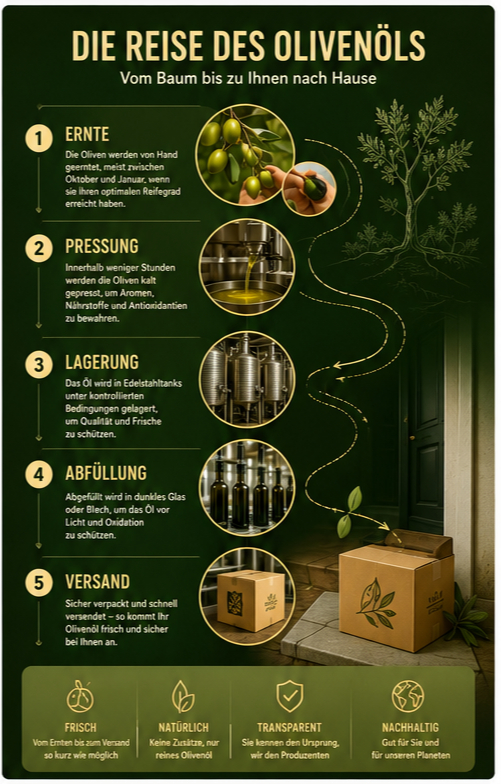
1. Why Buy Olive Oil Online?
Choosing to buy olive oil online, rather than at the supermarket, has real perks. Here’s what you gain.
Larger product selection. Online stores can stock dozens of single-estate and regional oils. A supermarket simply doesn’t have shelf space for that. Iline Organic’s full product range, for example, spans three distinct harvest-timed profiles plus a high-polyphenol option — more variety than most retail shelves carry.
Better quality products. Specialist retailers tend to focus on true extra virgin quality. They don’t just stock the cheapest bulk blend.
Access to small producers. Many artisan makers sell only through their own site or a boutique retailer. So buying online is often the only way to get real single-estate olive oil straight from the producer. Iline Organic’s producer story is a good example — the brand controls cultivation, bottling, and distribution itself, without intermediaries.
Competitive pricing. Cutting out extra layers of distribution can make premium olive oil more affordable. In fact, it’s often priced better than the same quality in a retail store.
Fresh harvest oils. Good shops sell early harvest olive oil soon after pressing. That beats oil that’s sat in a warehouse for a year or more.
Customer reviews. Real olive oil reviews from other buyers help you judge flavor and freshness before you commit.
Home delivery. Olive oil delivery brings the bottle to your door, often in packaging built for a delicate product. Some brands also offer subscription delivery, so a fresh bottle arrives automatically before you run out.
Exclusive premium products. Limited runs, award winners, and PDO olive oil are often sold only through specialty channels, not general retail.
Taken together, these reasons explain why so many shoppers now choose to buy olive oil online instead of settling for whatever sits on the supermarket shelf.
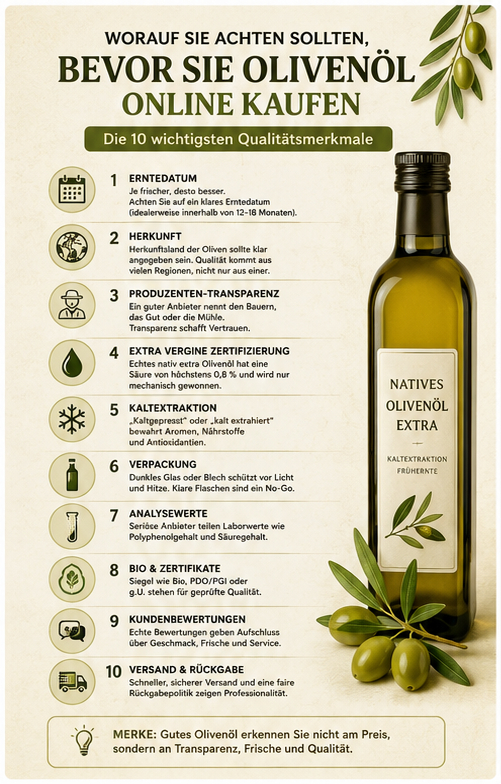
2. What to Look for Before You Buy Olive Oil Online
Before you buy olive oil online or place an order with a new retailer, run through these checks. Together, they separate a smart purchase from a disappointing one.
2.1 Harvest Date
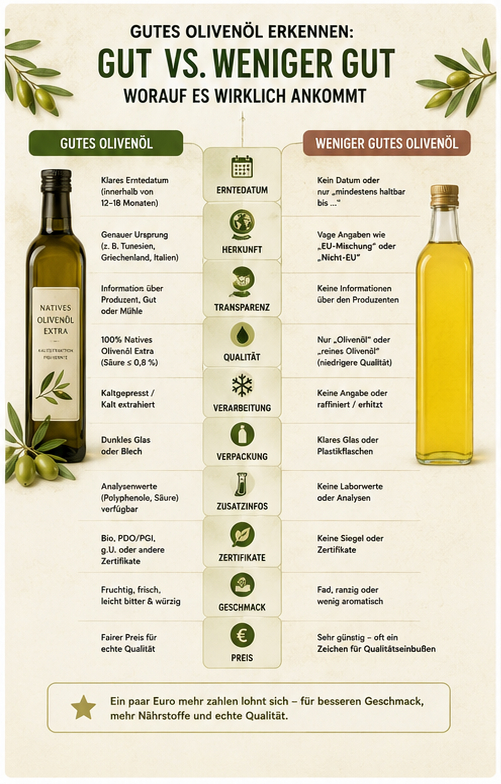
This is the single most important quality marker. Olive oil doesn’t improve with age like wine. Instead, its quality drops steadily from the moment the olives are pressed. So, look for a clear harvest date, such as “harvested November 2025.” Don’t settle for a distant “best by” date alone. Oil consumed within 12–18 months of pressing will taste and smell noticeably better than older oil. Some producers build this detail into every product listing — Iline Organic’s range, for instance, states the exact harvest window (October–November, December, or January) for each variety.
2.2 Country of Origin
By law, labels must state where the olives were grown and pressed. High-quality oil comes from many places. Mediterranean olive oil from Spain, Italy, Greece, and Tunisia is well known. But great oils also come from California, Chile, and Australia. What matters most isn’t a single “best” country. Instead, look for an origin that’s clear and specific, not a vague “Product of the EU.”
2.3 Producer Transparency
Trustworthy sellers name the estate, mill, or co-op behind the oil. If a site only shows a generic brand with no word on who grows or presses the olives, treat that as a warning sign, not just an oversight.
2.4 Extra Virgin Certification
“Extra virgin” is a legal, chemical standard. It’s not just a marketing phrase. According to the International Olive Council, which sets the global trade standard for the category, extra virgin olive oil must be obtained solely by mechanical or physical means, with a free acidity of no more than 0.8 grams per 100 grams. So, check that the label actually says “extra virgin.” Don’t settle for plain “olive oil” or “pure olive oil,” since those are lower grades under the same IOC classification.
2.5 Cold Extraction
Look for “cold-pressed” or “cold-extracted” on the label. This means the olives were processed at low heat. As a result, the oil keeps more flavor, aroma, and healthy compounds than heat-assisted oil.
2.6 Organic Certification
Organic olive oil comes from groves grown without synthetic pesticides or fertilizers. A recognized seal, like USDA Organic or EU Organic, is a solid trust signal — the USDA’s National Organic Program is the federal body that accredits certifiers and enforces the standard in the US. However, it’s a bonus, not a substitute for freshness and the right grade. Products like Iline Organic’s Dalia range carry certification under EU, Swiss, and USDA organic rules simultaneously, which is worth looking for if you want overlapping assurance.
2.7 Acidity Level
By law, extra virgin olive oil must have free acidity under 0.8%, per the IOC trade standard. Many top producers list a lower number, often 0.1%–0.3%, as proof of quality. So, when a shop shares a tested acidity level, that’s a real sign of transparency.
2.8 Bottle Material
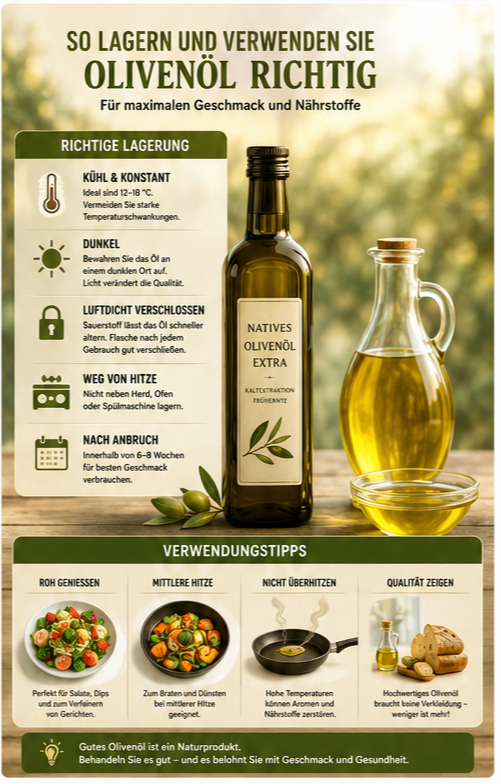
Light is one of the fastest ways to ruin olive oil. So, favor dark glass or a steel tin over clear glass or plastic. If a store ships premium oil in a clear bottle with no outer box, that’s a sign the seller hasn’t thought about preservation.
2.9 Storage Recommendations
Good sellers tell you how to store the oil once it arrives. For example, they’ll suggest keeping it away from heat and light, sealed tight, and used within a set window after opening. This kind of guidance shows a retailer that understands the product, not just the sale.
2.10 Awards and Quality Certifications
Independent recognition adds credibility. This includes wins at olive oil competitions, certified seals, or third-party lab checks. Also look for PDO (Protected Designation of Origin), PGI (Protected Geographical Indication), or DOP olive oil labels. The European Commission’s quality schemes page explains how these labels guarantee the oil came from, and meets the production standards of, a specific region.
3. How to Identify a Trustworthy Shop When You Buy Olive Oil Online
Beyond the bottle itself, it helps to judge the retailer as a business. Here’s what to check.
- Company information. A real address, contact details, and an “about us” page that names the producers or sourcing model — see Iline Organic’s about page for an example of the level of detail worth looking for.
- Customer reviews. Independent reviews, not just testimonials the seller picked, covering freshness, packaging, and service.
- Product transparency. Clear harvest dates, acidity levels, and variety info for each product, rather than generic marketing copy repeated across the catalog.
- Shipping policy. Set timelines and protective packaging, especially on routes prone to heat.
- Return policy. A fair, clear process if a bottle arrives damaged or doesn’t match its description — look for something like a defined money-back window rather than vague wording.
- Secure payment methods. Encrypted checkout and a recognized payment processor.
- Traceability. The ability to trace a bottle back to a specific harvest, mill, or lot number.
- Fresh inventory. Stock that turns over often, rather than the same “current harvest” oil listed year after year.
- Expert product descriptions. Detailed notes on flavor, best culinary uses, and how the oil was made. This is a sign the retailer truly knows olive oil, not just sales copy.
4. Comparing Online Shops vs Supermarkets
| Factor | Online Olive Oil Shop | Supermarket |
| Product variety | Wide range, including single-estate and regional oils | Limited to a handful of mainstream brands |
| Freshness | Often ships fresh harvest oil within months of pressing | Bottles may sit on shelves for a year or more |
| Quality | Built around extra virgin and premium grades | Mixed grades; quality varies widely |
| Pricing | Fair for premium and artisan oils; direct-from-producer savings possible | Convenient, but not always better value for the quality |
| Expert advice | Detailed descriptions, harvest data, sourcing notes | Little guidance beyond the label |
| Availability | Access to small-batch and international producers | Limited to what’s stocked locally |
| Convenience | Ordered from home, delivered to your door | Instant, with no shipping wait |
| Delivery | Protective packaging, though still subject to shipping conditions | None needed; you carry it home |
| Customer service | Direct contact with specialist retailers | Minimal, with general store staff |
Not sure which taste profile suits you before you order? Tools like Iline Organic’s product-matching quiz can help you pick between delicate, medium, and intense before checkout.
5. Common Mistakes When You Buy Olive Oil Online
- Choosing the cheapest option. A very low price often means old stock, a blend, or a lower grade sold as extra virgin.
- Ignoring the harvest year. A missing or vague harvest date is one of the biggest red flags in the industry.
- Not checking the origin. Vague claims like “Mediterranean blend,” with no specific country or estate, cut down on traceability.
- Buying oils in clear bottles. Clear glass lets in light, which damages the oil, especially during transit.
- Falling for misleading marketing claims. Words like “premium,” “gourmet,” or “cold-pressed” aren’t always regulated. So, look for real detail behind the label, not just the term itself.
- Ignoring storage conditions during shipping. Oil shipped through extreme heat, without insulation, can go bad before it even reaches your door.
6. Expert Buying Tips
- Find the best value for money. Compare price per liter across oils of similar quality, rather than just comparing bottle price.
- Choose authentic extra virgin olive oil. Confirm the label says “extra virgin,” not just “olive oil” or “light olive oil,” per the IOC’s official grading definitions.
- Compare products carefully. Weigh harvest date, acidity, and origin, not just price or packaging design.
- Read labels correctly. Check the harvest date, acidity percentage, and country of origin before you read the marketing copy.
- Understand certifications. Organic, PDO, PGI, and DOP each verify a different part of the production process — see the USDA National Organic Program and the EU’s quality schemes overview for how each is actually regulated.
- Buy directly from producers when you can. This usually means better traceability and, often, better pricing.
- Store the oil properly after delivery. Keep it in a cool, dark cupboard, sealed tight between uses.
7. Conclusion
When you buy olive oil online, you can get fresher, more authentic oil than most supermarkets offer. But that’s only true if you know what to check. So, prioritize the harvest date, a verified origin, Extra Virgin certification, and a retailer that’s open about sourcing and shipping. Treat price as just one factor, not the deciding one. A slightly higher price for a traceable, recently harvested, well-packaged bottle is almost always the smarter buy over the cheapest option on the page.
8. Buying Checklist
- Harvest date listed (within the last 12–18 months)
- Country or region of origin clearly stated
- Labeled “extra virgin,” not just “olive oil”
- Cold-pressed or cold-extracted
- Acidity level shared (ideally well under 0.8%)
- Dark glass or tin packaging
- Producer or estate named
- Organic, PDO, PGI, or DOP certification (where it applies)
- Verified customer reviews
- Clear shipping and return policy
- Secure checkout
9. FAQ
Is it safe to buy olive oil online? Yes, it usually is. Buying from an established, open retailer with secure payment and clear shipping is generally just as safe as buying in person. Often, it also gets you fresher, better-documented oil.
Where can I buy authentic extra virgin olive oil online? Look for specialist olive oil shops or producer sites, such as Iline Organic, that share the harvest date, origin, acidity level, and certifications. Avoid general marketplaces that give little product detail.
How do I know if an online olive oil shop is trustworthy? Check for clear company information, independent reviews, detailed product descriptions, and a defined shipping and return policy. Also confirm the checkout is secure.
What certifications should I look for? Look for Extra Virgin grading first, as defined by the International Olive Council. Then check for organic certification and regional labels like PDO, PGI, or DOP, which confirm both origin and production standards.
How can I identify high-quality olive oil? Check the harvest date, confirm the label says “extra virgin,” and look for a disclosed acidity level under 0.8%. Also favor dark glass or tin, since it blocks damaging light.
Is buying directly from producers better? Often, yes. Buying direct usually means better traceability and fresher stock. Sometimes, it also means better pricing, since it skips extra layers of distribution.
How is olive oil safely shipped? Good sellers use protective, insulated packaging. Where possible, they also avoid shipping through extreme heat, since high temperatures can speed up spoilage in transit.
Is premium olive oil worth the higher price? For most buyers, yes. Premium and single-estate oils tend to be fresher, more traceable, and richer in flavor than mass-market blends. Still, taste and budget matter too.
How should olive oil be stored after delivery? Keep it sealed and away from heat and direct light. A cool cupboard works better than a spot next to the stove. Try to use it within a few months of opening.

Downloads
Video summary