

Listen to summary
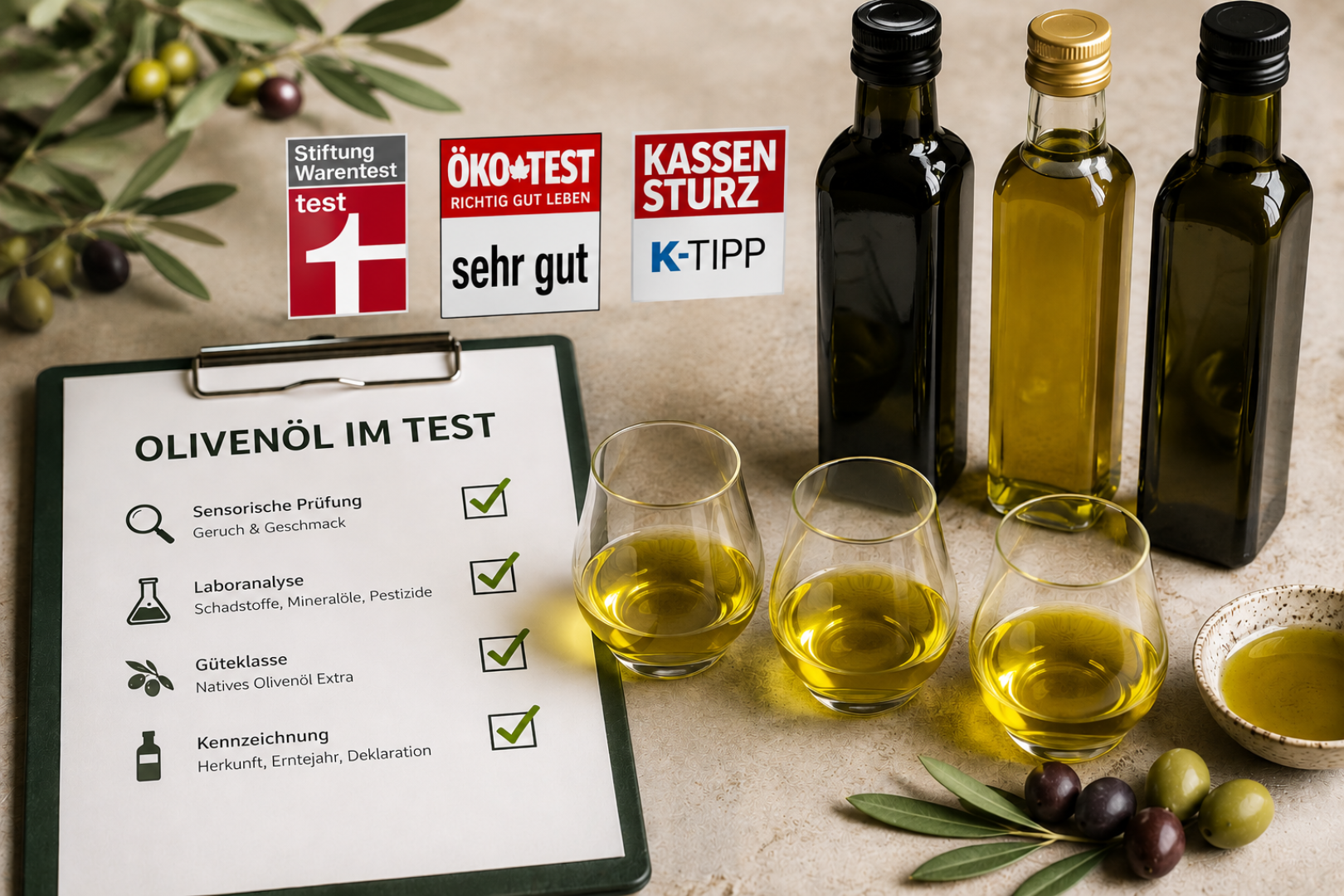
A good olive oil isn’t recognized by its prettiest label. Nor reliably by its price. That’s exactly what the major consumer magazines have shown for years: many bottles are sold as “extra virgin”, yet don’t always pass this highest quality grade in testing.
Anyone searching for “olive oil put to the test” usually wants a clear answer: which oil is good — and which test can I trust? The more honest answer is: a single test winner only helps to a limited extent. What matters far more is understanding how Stiftung Warentest, ÖKO-TEST and Kassensturz/K-Tipp test, why their results can differ, and which patterns repeat across several years.
This article summarizes the key findings from the consumer magazines and explains how to actually use test results when shopping. For a separate retailer-by-retailer look at Migros, Coop, Aldi, Lidl & Co., we deliberately link to the specialized article Olive Oil in Swiss Retail. This article isn’t about retail — it’s about the testing logic of the magazines.


1. The Key Points at a Glance
- “Extra virgin” is a quality promise — not an automatic guarantee.
The highest grade requires a flawless oil with fruity notes and no sensory defects. - Stiftung Warentest shows a clear downward trend.
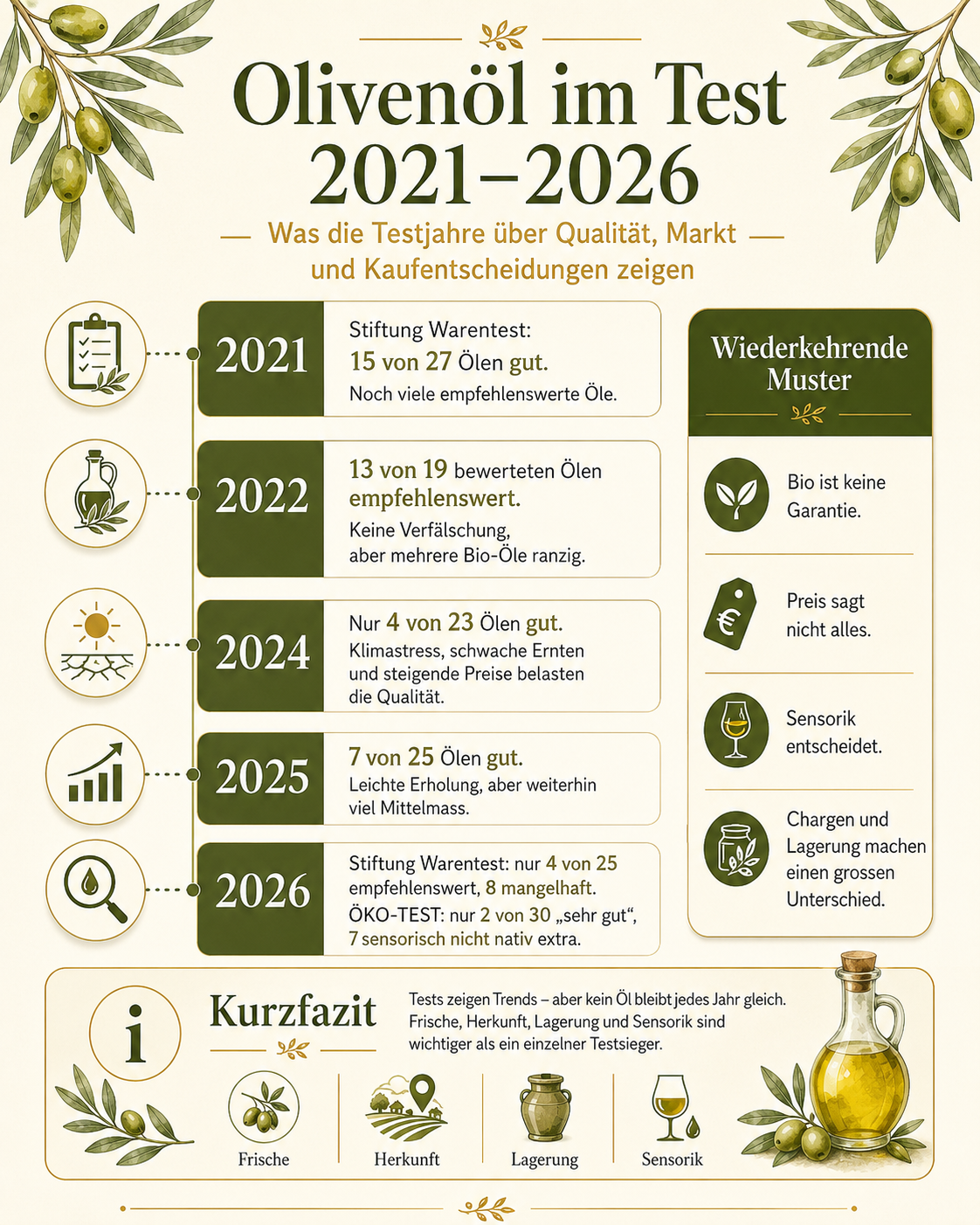
In 2021, 15 of 27 oils still scored well; by 2026, only 4 of 25 were recommendable. - ÖKO-TEST found only two “very good” oils in 2026
and classified seven of 30 tested oils as not meeting the highest grade sensorially. - Kassensturz/K-Tipp sensorially tested Swiss bestsellers in 2025.
Two oils were “very good,” ten passed as extra virgin; one oil failed as merely “virgin.” - Organic and a high price help — but not always.
Organic protects at the growing stage but doesn’t prevent oxidation, poor storage, or contamination from processing and transport. - Tests are snapshots in time.
Olive oil quality depends on the batch. Harvest year, storage, bottling and transport all play a role.
2. Why Do So Many Olive Oils Fail the Test?
The most common reason is simple: an oil doesn’t smell or taste flawless. For extra virgin olive oil, a single clear sensory defect is enough to disqualify the label.
Typical defects include:
- rancid: the oil was exposed to oxygen, light or heat for too long.
- fusty/muddy: the olives began to ferment before processing.
- musty/humid: the fruit or storage conditions were problematic.
- winey or vinegary: signs of unwanted fermentation.
The problem: you can’t see these defects on the bottle. That’s why sensory testing by trained panels is so important. If you want to train your own nose, read the Olive Oil Quality & Tasting Guide alongside this article.
3. Stiftung Warentest, ÖKO-TEST, Kassensturz: What Is Actually Being Tested?
Stiftung Warentest: Sensory Testing Plus Lab Analysis, Strong Focus on Overall Quality
Stiftung Warentest combines sensory evaluation with laboratory analysis. Testers check whether an oil truly matches the “extra virgin” grade, whether it tastes balanced, and whether contaminants such as mineral oil residues or plasticizers show up.
The multi-year view is especially revealing:
| Test Year | Stiftung Warentest Result | Assessment |
| 2021 | 15 of 27 oils good | Many recommendable oils, two standout flavors |
| 2022 | 13 of 19 rated oils recommendable | No signs of adulteration, but several organic oils rancid |
| 2024 | Only 4 of 23 oils good | Significantly poorer quality, climate stress and higher prices |
| 2025 | 7 of 25 oils good | Slight recovery, but still a lot of mediocrity |
| 2026 | Only 4 of 25 oils recommendable | Eight inadequate, including well-known discount products |
The key finding: Stiftung Warentest doesn’t just assess whether an oil appears “clean.” An oil also has to be sensorially convincing. That makes the results valuable in everyday life, because taste isn’t a luxury detail for olive oil — it’s part of the legal quality standard.
ÖKO-TEST: Strong on Contaminants, But Also Tests Sensory Quality
ÖKO-TEST traditionally puts a lot of weight on residues, pesticides, mineral oil components and other unwanted substances. In the 2026 olive oil test, the magazine also had oils tasted and reached a tough conclusion: of 30 oils tested, seven should not have been sold as “extra virgin” according to the sensory panel. Only two oils received the top rating of “very good.”
Particularly relevant is the finding on multiple pesticide residues. Organic oils aren’t automatically free of problems either, because contamination doesn’t only originate in the field. Residues can also enter the supply chain via machinery, hoses, transport, storage or packaging.
Kassensturz/K-Tipp: A Swiss Perspective With a Sensory Focus
For Switzerland, the Kassensturz/K-Tipp test is especially interesting. A Swiss olive oil panel tested 13 of the best-selling extra virgin olive oils from Swiss retail. The result was better than some German tests: two oils received “very good,” eight more received “good.” One product, however, was classified as defective and should not have been labeled extra virgin.
Important: this article does not turn this into a retailer comparison. That’s exactly what the separate deep dive Olive Oil in Swiss Retail is for. Here, the Swiss test mainly serves as proof that sensory quality is decisive even for everyday bestseller oils.
4. Why Do Olive Oil Tests Sometimes Contradict Each Other?
Different results don’t automatically mean one magazine is wrong. There are several reasons for discrepancies with olive oil.
Different Batches Are Being Tested
Olive oil isn’t a standardized industrial product like sugar. Quality depends on harvest timing, olive variety, weather, processing, bottling and storage. A brand can perform well one year and disappoint the next.
The Institutes Weight Criteria Differently
One magazine puts more weight on contaminants, another on sensory quality and harmony. Stiftung Warentest combines both into a single quality verdict. ÖKO-TEST pays very close attention to residues and downgrades for them. Kassensturz/K-Tipp focused heavily on sensory classification in this particular test.
“Good” Doesn’t Always Mean “Gourmet”
A good everyday oil must be flawless and clean. It doesn’t need to taste intense, peppery or especially complex. Conversely, a bold, expressive oil can be excellent for salad and bread but too precious for heating. For the right use case, see our Olive Oil Food Pairing Guide.
The Market and Storage Conditions Change Quickly
Heat, light and oxygen are olive oil’s enemies. An oil can still be good at the bottler and lose quality in retail due to long or warm storage. That’s why tests should be read as guidance — not as a permanent guarantee.
5. The Most Important Lesson From the Tests: “Extra Virgin” Must Taste Fresh
The extra virgin grade isn’t just a chemical category. It’s also a sensory one. An oil must not taste rancid, musty or fusty. At the same time, it must be fruity. Bitterness and pungency are positive traits, since they’re often linked to fresh olives and polyphenols.
Important: a mild olive oil isn’t automatically worse. An extra virgin oil can be mild, harmonious and still correct. What matters isn’t maximum pungency, but freshness, flawlessness and balance. If you want to compare different profiles, try our Olive Oil Comparison or go straight to the Olive Oil Finder.
6. What the Test Years 2021 to 2026 Reveal About the Market
2021 and 2022: Many Good Oils, But Early Warning Signs
In 2021, Stiftung Warentest could still recommend more than half of the tested oils. There were even two sensory standouts for connoisseurs. 2022 also looked solid: 13 of 19 rated oils were recommendable, and no adulteration with other vegetable oils was found.
At the same time, familiar problems appeared: rancid organic oils, mineral oil components, plasticizers and significant price differences. Even then it was clear: brand, organic label and high price only partly explain quality.
2024: Climate Stress Reaches the Olive Oil Test
In 2024, Stiftung Warentest described significantly poorer overall quality. Extreme heat, water shortages and pests had taken a toll on olive trees around the Mediterranean. EU production dropped sharply, prices rose. Only 4 of 23 tested oils were good.
This period matters for context: when harvests are weak, high-quality raw oil becomes scarcer. That raises the risk that private-label brands and bottlers purchase less harmonious or more defect-prone batches.
2025: A Slight Recovery, But No Reason for Complacency
In 2025, Stiftung Warentest found 7 good oils among 25 products. Some discount and private-label brands performed better than the previous year. At the same time, oils continued to fail due to flavor defects or contaminants. The message: the market can recover, but remains volatile.
2026: Good Olive Oil Remains Rare
In 2026, the number of recommendable oils at Stiftung Warentest dropped again to 4 of 25. Eight products were inadequate. ÖKO-TEST reached an equally strict verdict the same year: only two of 30 oils were “very good,” and seven should not have been classified as “extra virgin” sensorially.
For consumers, that means: test-winner lists are helpful, but they don’t replace your own purchasing criteria.
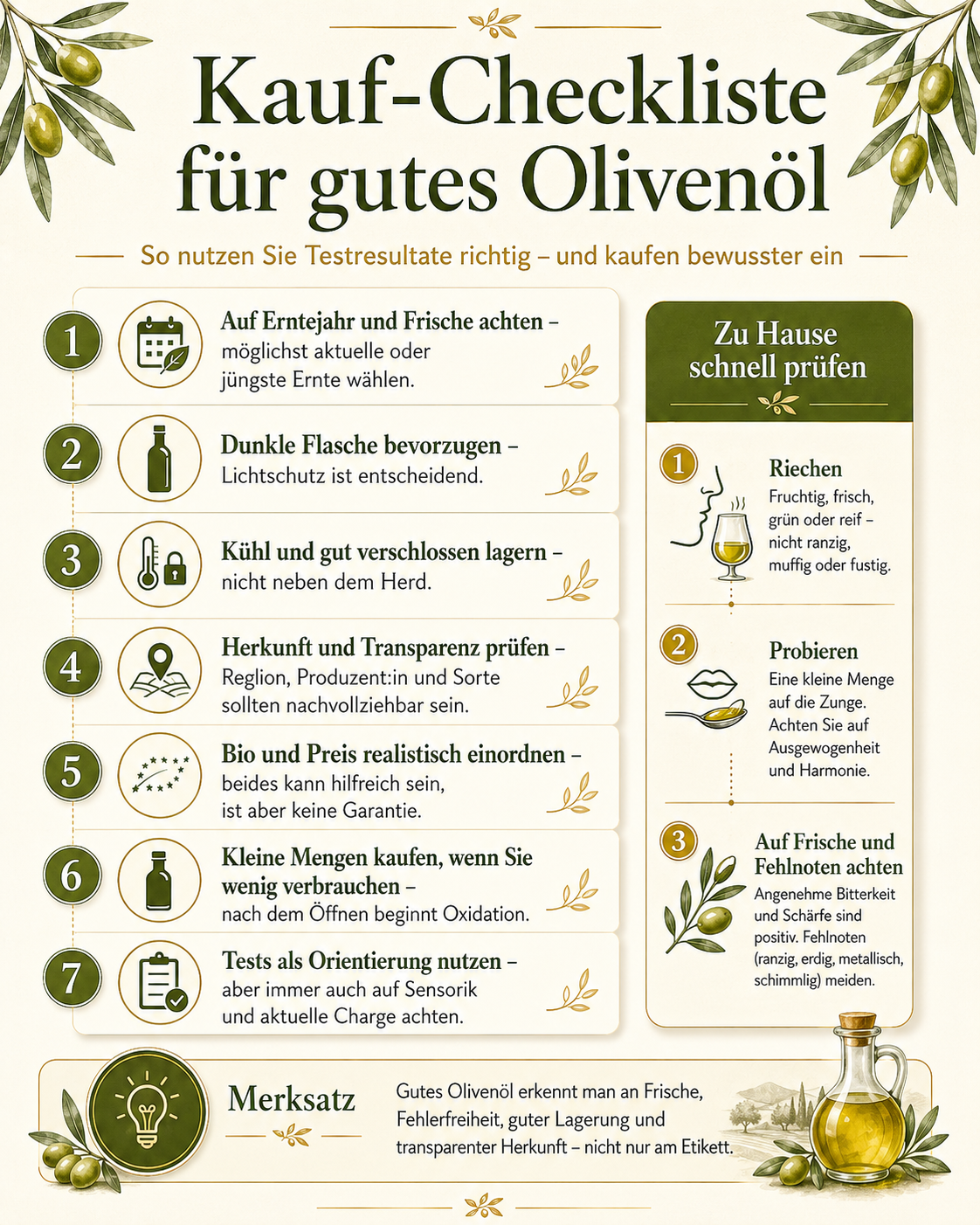
7. Buying Checklist: How to Actually Use Olive Oil Tests
Pay Attention to Harvest Year and Freshness
A good olive oil should ideally come from the current or most recent harvest. The fresher the oil, the higher the chance of green aromas, bitterness, pungency and stable polyphenols.
Don’t Buy Large Quantities Without a Consumption Plan
Oxidation begins once the bottle is opened. Buy smaller containers if you use little oil. For households with high consumption, a well-protected bag-in-box system can make sense, since it reduces light and oxygen exposure. You’ll find suitable formats in the Iline Store.
Prefer Dark Bottles and Protected Storage
Olive oil should be stored in a dark, cool place and sealed well. Avoid bottles displayed under bright light or in warm spots in the store. At home, olive oil doesn’t belong next to the stove.
Check Origin and Transparency
Specific origin, harvest details, olive varieties and traceable production are worth more than a generic premium label. Learn more about how olive oil is made in our Olive Oil Production guide.
Don’t Rely Blindly on Price or Organic Labels
Organic farming matters for soil health, biodiversity and sustainable agriculture. But even organic oil can turn rancid or become contaminated during processing or storage. Learn more about our approach under Organic Farming and Sustainable Olive Farming.
Learn to Recognize Defects by Smell
A fresh oil smells like grass, herbs, tomato, green almond, apple or artichoke. A defective oil seems dull, old, waxy, musty or vinegary. Try a simple test at home: pour a little oil into a small glass, warm it slightly with your hand, smell it, then taste slowly.
8. What Does This Mean for Iline Organic?
Above all, the consumer magazine tests show one thing: trust doesn’t come from a single label, but from transparency across the entire chain. This is exactly where Iline Organic should be clearly positioned in its content.
Iline doesn’t need to claim that every supermarket oil is bad. The far stronger message is: if you don’t want to play a guessing game, choose an oil where origin, cultivation, flavor profile and use are clearly explained.
Good starting points:
- If you want to cook mild and approachable, start with Hana – Delicate Olive Oil.
- If you’re looking for a versatile everyday oil, compare Yara – Balanced Olive Oil.
- If you love intense bitterness and pungency, check out Dalia – Robust Olive Oil.
- If polyphenols are your priority, read more about Polyphena – High Polyphenol Olive Oil.
- If you prefer biodynamic farming, discover Heritage – Demeter Olive Oil.
9. Conclusion: An Olive Oil Test Is a Starting Point — Not the End of the Decision
The major consumer magazines are valuable because they reveal what consumers can hardly check for themselves: sensory defects, contaminants, plasticizers, mineral oil residues and labeling problems.
But the most important takeaway from all these tests isn’t a single test winner. The most important takeaway is: good olive oil needs freshness, clean processing, proper storage and traceable origin. Anyone who understands these criteria buys better — regardless of which product currently tops a table.
If you’re looking for an olive oil that suits your taste and your kitchen, start with the Olive Oil Finder or compare profiles in our Olive Oil Comparison. If you specifically want to know how Swiss retailers perform in detail, read the separate article Olive Oil in Swiss Retail.
10. Frequently Asked Questions About Olive Oil Tests
Which olive oil is the best in the test?
That depends on the test year, the batch and the institute. Stiftung Warentest, ÖKO-TEST and Kassensturz don’t always test the same products. That’s why it makes more sense to focus on recurring quality markers: fresh harvest, flawless sensory profile, clear origin, dark packaging and careful storage.
Why does an olive oil fail despite being labeled “extra virgin”?
Because “extra virgin” requires a flawless sensory profile. If an oil smells or tastes rancid, musty or fusty, it no longer meets the highest grade. Contaminants can also lead to a downgrade.
Is Stiftung Warentest or ÖKO-TEST more important?
Both are helpful, but they emphasize different things. Stiftung Warentest combines sensory quality, chemical quality and contaminants into one overall verdict. ÖKO-TEST is particularly strict on residues and contaminants, but also considers sensory results. For consumers, combining both perspectives is strongest.
What does Kassensturz/K-Tipp show for Switzerland?
The Swiss test shows that even everyday bestsellers can differ significantly in sensory quality. Some oils achieved very good or good results, while one product failed to meet the extra virgin requirement. For a retailer comparison, see our separate retail article.
Is expensive olive oil automatically better?
No. Tests repeatedly show that expensive oils can fail while cheaper oils perform well. Price can relate to craftsmanship, origin and yield, but it’s no proof of quality.
Is organic olive oil automatically better?
Organic is a strong signal for ecological farming. But it doesn’t automatically guarantee a flawless sensory profile. Organic oils, too, can turn rancid or become contaminated through processing, transport or storage.
Can extra virgin olive oil be mild?
Yes. An extra virgin olive oil can be mild, balanced and still high quality. It doesn’t need to be extremely bitter or pungent. What matters is that it’s fruity and free of sensory defects.
Can you fry with extra virgin olive oil?
Yes, good extra virgin olive oil is suitable for gentle frying. However, highly aromatic or especially polyphenol-rich oils are often too precious for high-heat cooking. They work best raw — over salad, vegetables, pasta or with bread.
How do I recognize rancid olive oil?
Rancid oil smells old, dull, waxy or like stale nuts. It tastes flat and unpleasant. Fresh oil, by contrast, smells of green or ripe olives, grass, herbs, apple, almond, tomato or artichoke.
How long does olive oil stay good?
Unopened, shelf life depends on harvest, bottling and storage. Once opened, a bottle should ideally be used within a few months. Dark, cool storage and a well-sealed pourer help preserve aromas longer.

Downloads
Video summary