

Listen to summary
Extra virgin olive oil and refined olive oil sit side by side on every supermarket shelf. They often carry very different prices too. At first glance, the bottles look similar. However, what’s inside them, and what each oil is actually good for, can be worlds apart.
In this guide, we break the topic down step by step. First, we explain how producers make each type of oil. Then, we compare taste, smoke point, and health benefits. After that, we cover price and shelf life. Finally, we help you decide which oil actually belongs in your kitchen.



1. What Is Extra Virgin Olive Oil?
Extra virgin olive oil, often shortened to EVOO, is the highest grade of olive oil available.
1.1 How Producers Make It
Producers make extra virgin olive oil solely through mechanical extraction. No heat gets added. No solvents or chemicals get used either. Workers wash and crush the olives shortly after harvest. Then they cold-press or centrifuge the paste. This gentle process preserves the natural aromas, polyphenols, and vitamins that give the oil its character.
1.2 The Three Legal Requirements
To legally carry the “extra virgin” label, an oil must meet three conditions:
- Purely mechanical extraction — no solvents or chemical treatment
- Free acidity below 0.8% — a measure of how degraded the oil is; lower is better
- Zero sensory defects — a trained tasting panel must detect no faults, such as rancid or musty notes, and must confirm positive traits like fruitiness
Origin, olive variety, and harvest timing all shape the final flavor. As a result, no two extra virgin oils taste the same. For example, our own range spans the mild Hana, the balanced Yara, and the more robust, peppery Dalia. Each one offers a distinct flavor profile.
2. What Is Refined Olive Oil?
Refined olive oil starts life as a failed batch. Producers make it from oils that initially fail to meet virgin-grade standards, often due to high acidity or sensory flaws. These oils aren’t fit for sale as-is.
2.1 The Refining Process
So producers run the oil through a chemical and thermal refining process. This process strips out acidity, color, and flavor. The result is a nearly neutral, pale-yellow oil.
What stores typically sell simply as “olive oil,” or sometimes as “pure” or “light” olive oil, is usually a blend. It combines refined oil with a small percentage of virgin oil, added back for flavor. According to the International Olive Council, the global authority that sets official grading standards, only oils obtained purely by mechanical or physical means qualify as “virgin.” Refined oil, by contrast, falls into a separate category entirely.
Our Classic Everyday Olive Oil is built for exactly this kind of versatile, high-heat, budget-friendly everyday cooking.
3. Key Differences at a Glance
| Feature | Extra Virgin Olive Oil | Refined Olive Oil |
| Production | Purely mechanical, no heat or chemicals | Chemical and thermal refining |
| Flavor | Fruity, sometimes peppery or bitter, depending on variety and harvest | Neutral, nearly flavorless |
| Color | Green to golden yellow | Very pale, almost colorless |
| Polyphenols & vitamins | High, since the oil stays unprocessed | Significantly reduced by refining |
| Smoke point | Roughly 190–210°C (375–410°F) | Roughly 220°C (428°F) |
| Shelf life after opening | Shorter; sensitive to light and heat | Longer; more heat- and oxidation-stable |
| Best for | Dressings, dips, finishing, gentle cooking | Deep-frying, high-heat searing, neutral recipes |
4. Can You Actually Cook With Extra Virgin Olive Oil?
A persistent myth claims that extra virgin olive oil isn’t suitable for cooking. In reality, its smoke point tells a different story.
4.1 The Smoke Point Myth
The smoke point of extra virgin olive oil sits at roughly 190–210°C, or 375–410°F. That comfortably covers most home cooking. Think searing vegetables, pan-frying fish, or roasting. Refined olive oil’s slightly higher smoke point, around 220°C, mainly matters for deep-frying or very high-heat searing.
4.2 What the Research Actually Shows
A widely cited 2018 study from Modern Olives Laboratory in Australia tested ten common cooking oils under heat. The researchers found something surprising. Extra virgin olive oil produced the fewest harmful oxidation byproducts. It even outperformed oils with a nominally higher smoke point. Why? Its high share of monounsaturated fat helps. So do its polyphenols. Together, they make the oil unusually resistant to breaking down under heat. So for most everyday cooking, a good extra virgin oil holds up well. Only at the extreme end, deep-frying, does refined oil’s higher ceiling become genuinely useful.
5. Flavor and Aroma
This is where the two oils diverge most.
5.1 The Case for Extra Virgin
Extra virgin olive oil carries the full aromatic range of the olive. Depending on variety, ripeness, and terroir, it can taste grassy and green, fruity, or bitter and peppery on the finish. That character is exactly why it shines as a finishing oil. Try drizzling it over salads, grilled vegetables, soups, or fresh bread.
5.2 The Case for Refined
Refined olive oil, by contrast, tastes deliberately neutral. That’s not a flaw; it’s the point. A neutral oil won’t compete with the other flavors in a dish. Therefore, it works well in recipes where you want the oil to stay in the background.
6. Health Considerations
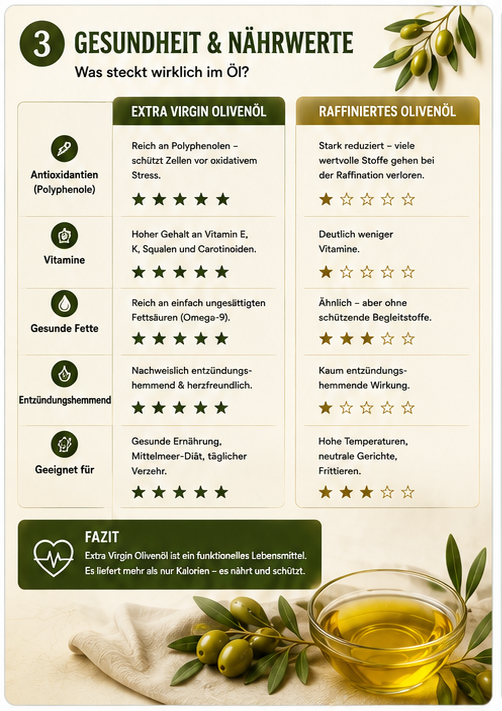
Most experts consider extra virgin olive oil the healthiest grade of olive oil available.
6.1 What Extra Virgin Retains
Because it stays unprocessed, extra virgin olive oil retains its full complement of polyphenols, vitamin E, and vitamin K. These compounds carry antioxidant and anti-inflammatory properties. Researchers link them closely to the well-documented cardiovascular benefits of the Mediterranean diet. If polyphenol content matters most to you, our Polyphena High Polyphenol Olive Oil is crafted specifically for that purpose. You can read more about the science behind these compounds in our Health and Science stories.
6.2 What Refining Removes
Refining strips out most of these heat-sensitive micronutrients. Chemically, refined olive oil still consists mostly of the same monounsaturated fats as virgin oil. However, it lacks the protective compounds that make extra virgin oil nutritionally superior. In short, it’s not unhealthy. It’s just less nutrient-dense.
7. Price and Shelf Life
Extra virgin olive oil takes more work to produce.
7.1 Why Extra Virgin Costs More
Producers must process olives quickly after harvest. They press the fruit gently, then run strict quality checks before the oil reaches shelves. This drives the price up. The oil is also more perishable. Once you open the bottle, use it within a few months. Store it away from light and heat, since both accelerate the breakdown of its aromas and polyphenols.
7.2 Why Refined Costs Less
Refined olive oil, on the other hand, costs less and stays more stable. It contains few of the delicate compounds that oxidize over time. As a result, it holds up longer after opening without a noticeable drop in quality.
8. Which Oil Fits Which Purpose?
- Salads, dips, cold sauces, finishing: extra virgin olive oil — this is where its aroma really comes through.
- Gentle sautéing, roasting, baking: extra virgin or virgin olive oil — the smoke point easily covers most home recipes.
- Deep-frying or very high-heat searing: refined olive oil — higher smoke point, neutral flavor.
- Dishes with other dominant flavors: refined olive oil, so it doesn’t compete with the rest of the dish.
Still not sure which bottle fits your kitchen? Try our Olive Oil Finder, or compare our products side by side. For inspiration, check out our Food Pairing guide and recipe collection.
9. How to Buy Genuinely Good Extra Virgin Olive Oil
9.1 Label Checklist
- Look for the words “extra virgin,” not just “olive oil” or “light olive oil.”
- Check for a harvest or bottling date. Fresher oil tastes better.
- Choose a dark glass bottle, since light degrades quality fast.
- Favor a clear origin and olive variety over an anonymous blend.
9.2 Storage Tips at Home
Once opened, store extra virgin olive oil in a cool, dark cupboard. Keep it away from the stove and direct sunlight. Also, keep the cap tightly closed between uses. Try to finish the bottle within a few months for the best flavor.
10. Common Myths About Extra Virgin Olive Oil
“It’s Too Delicate to Cook With”
Not true. As the smoke point data above shows, extra virgin olive oil handles most home cooking without issue.
“All Extra Virgin Oils Taste the Same”
In reality, olive variety, origin, and harvest timing create huge flavor differences. Extra virgin oils range from mild and buttery to intensely grassy and peppery.
“Refined Olive Oil Is Unhealthy”
Not quite. Refined oil still consists mostly of monounsaturated fat. It’s simply less nutrient-dense than extra virgin, not harmful on its own.
11. The Bottom Line
Extra virgin and refined olive oil simply serve different purposes in the kitchen. For flavor, aroma, and nutritional value, nothing beats a high-quality extra virgin olive oil. It’s the least processed and most nutrient-rich option available. Refined olive oil earns its place too, thanks to its heat tolerance, neutrality, and lower price tag.
If you only want to keep one oil at home, a good extra virgin olive oil is usually the smarter choice. It handles both cold applications and most everyday cooking. At the same time, it delivers the full flavor and nutrient profile of the olive. Ready to make the switch? See how easy it is to switch to a better olive oil, or browse the full Iline Organic store.
Curious about how olive oil is graded, where it comes from, and what makes ours different? Explore our full Olive Oil hub, or learn about our roots in Tunisia and how we produce our oil.
12. Frequently Asked Questions
Can I cook with extra virgin olive oil? Yes. Its smoke point of roughly 190–210°C (375–410°F) handles most home cooking, including sautéing and roasting. Refined oil only offers a meaningful advantage for very high-heat cooking, like deep-frying.
Why is refined olive oil cheaper? Producers make it from oils with initial quality defects. Then they correct those flaws through an industrial refining process. This route takes less labor than the gentle cold-pressing that virgin oils require.
Does refined olive oil still offer health benefits? It still consists mostly of monounsaturated fat. However, refining removes most of the polyphenols, vitamins, and aromatic compounds that make extra virgin olive oil nutritionally superior.
How do I recognize good extra virgin olive oil in the store? Look for the “extra virgin” label, a harvest or bottling date, and a dark glass bottle that blocks light. Ideally, the label should also list the origin and olive variety.
How long does extra virgin olive oil last once opened? Most bottles hold their quality for a few months after opening, as long as you store them away from heat and light. For more buying tips, see our full FAQ.

Downloads
Video summary