

Listen to summary
Cold-pressed olive oil sits on almost every bottle in the olive oil aisle. The term sounds premium, and it sounds traditional too. But what does cold-pressed olive oil really mean? Does it live up to the promise?
In this guide, we break it down step by step. First, we explain how mills make cold-pressed olive oil. Then, we cover the legal rules behind the term. After that, we look at why “first pressing” is now more of a baseline standard than a special claim. Finally, we show you how to spot genuinely high-quality cold-pressed olive oil at the store.
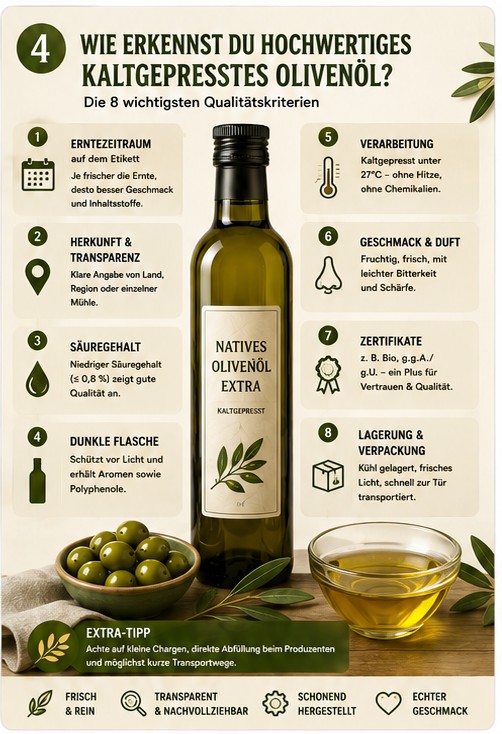
1. What Does “Cold-Pressed” Actually Mean?
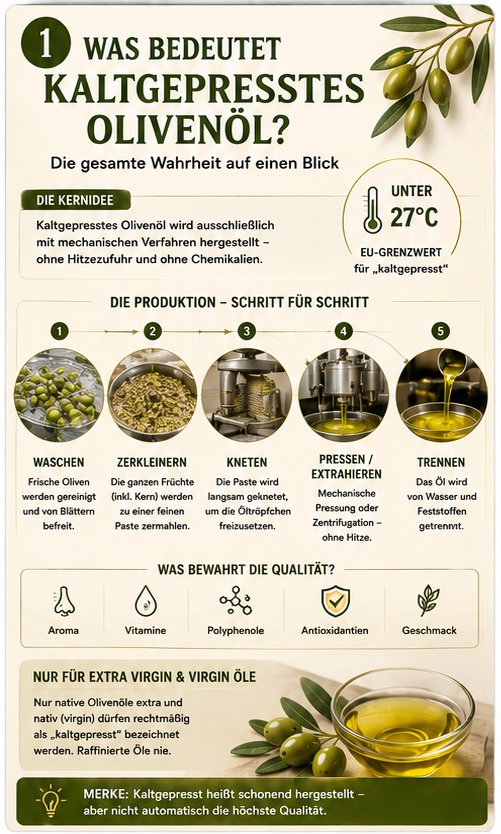
Cold-pressed olive oil comes from a purely mechanical process. No heat gets added. No solvents or chemicals get used either.
1.1 The Production Process, Step by Step
First, the mill washes the fresh olives. This removes leaves, twigs, and dirt. Next, it crushes the whole fruit into a fine paste, pit included. After that, weather a hydraulic press or an extraction machine squeezes the oil out of the paste. No external heat gets added at this stage. Finally, a decanter or centrifuge separates the oil from the leftover fruit water and solids. As a result, the oil comes straight from the fruit. Nothing gets added, and nothing gets chemically altered.
1.2 The 27°C Rule Explained
However, the word “cold” doesn’t mean room temperature. Instead, it refers to the paste’s temperature during pressing. EU rules set a clear limit here: 27°C, or 81°F. Below that line, the oil keeps its aroma, vitamins, and polyphenols intact. Above it, the oil loses both flavor and nutrients. Heat simply breaks down the delicate compounds that give good olive oil its character.
One detail matters most here. Only extra virgin and virgin olive oil can legally use the term “cold-pressed.” Refined oils never qualify, no matter how mills process them. For example, our own extra virgin oils prove the point. Hana, Yara, and Dalia are all genuine cold-pressed olive oil. Each one goes through this same gentle process, just with different olive blends and flavor intensities.
2. Cold-Pressed vs. Cold-Extracted: Is There a Real Difference?
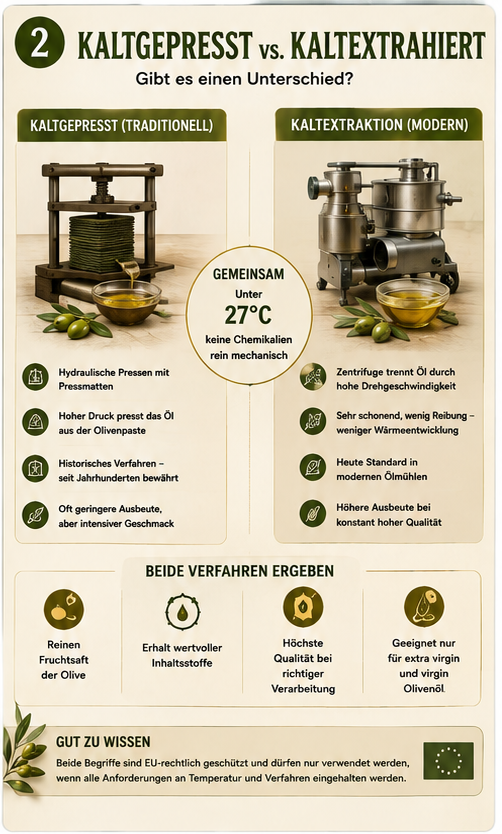
A newer method exists alongside classic cold-pressed olive oil: cold extraction. Both methods stay below 27°C. Neither one uses chemicals. The real difference sits purely in the technique.
2.1 Traditional Cold Pressing
A hydraulic press pushes the olive paste through press mats under high pressure. A decanter then separates the oil from the fruit water. This method dates back centuries. It still shapes how many people picture olive oil production, even though few mills still use press mats today.
2.2 Modern Cold Extraction
A centrifuge spins the paste at high speed. This separates the oil from water and solids, much like a juicer on a larger scale. Many producers see this as the gentler, more modern method. Less pressure means less friction, and less friction means less heat. Consequently, most large-scale producers today use cold extraction rather than traditional pressing. Many still call the result “cold-pressed” out of habit.
Overall, EU marketing standards regulate both terms closely. So mills can only use them for extra virgin and virgin oil made below 27°C. If you want the exact legal wording, you can read it directly through the European Commission (EUR-Lex).
3. Olive Oil First Pressing: Where Does the Term Come From?
“Olive oil first pressing” has a long history behind it. Understanding that history explains why the term means less than it used to.
3.1 Why a Second Pressing Used to Exist
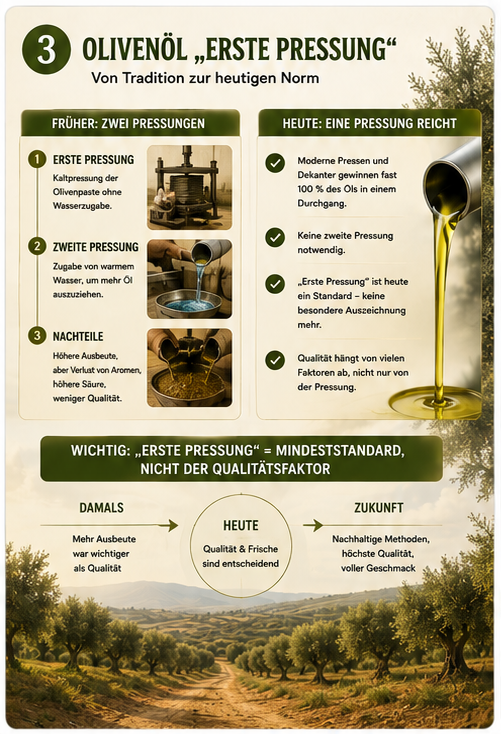
Mills once pressed the olive paste more than once. After the first, cold press, workers would add warm water. Then they pressed the leftover pulp again to squeeze out more oil. This second pressing boosted yield. That mattered a lot when olive oil was scarce and expensive to produce. Unfortunately, it also hurt the oil’s quality. The added heat destroyed delicate aroma compounds and raised acidity.
3.2 Why It Disappeared
Today, modern mills work differently. Powerful presses and centrifuges now pull out nearly all the oil in a single pass. Therefore, a second press simply isn’t needed anymore. In other words, “first pressing” describes a standard rather than a special step. Every good cold-pressed olive oil already meets it by default. Even so, the phrase lives on, since it signals tradition and care, even without a real technical difference behind it today.
4. Is Cold-Pressed Olive Oil Automatically High Quality?
Cold pressing alone doesn’t guarantee top quality. Today, it’s simply a baseline requirement, not a special feature. Instead, good cold-pressed olive oil depends on several other factors working together.
4.1 Olive Variety and Ripeness
Different olive varieties produce different flavor profiles. Some taste mild and buttery, while others turn out intensely peppery. Ripeness at harvest matters too. Earlier harvests generally produce more bitter, robust oil with higher polyphenol levels. Later harvests give a milder, smoother taste.
4.2 Time Between Harvest and Pressing
The clock starts ticking the moment olives leave the tree. Oxidation and fermentation begin almost immediately. So the shorter the gap between harvest and pressing, the fresher and more aromatic the final oil turns out. Many premium producers press their olives within hours of picking them.
4.3 Origin and Growing Conditions
Soil, climate, and altitude all shape how olives develop, much like terroir shapes wine. Origin also affects sustainability and traceability. This matters more and more to buyers who want to know exactly where their oil comes from.
4.4 Storage After Bottling
Even excellent cold-pressed olive oil degrades if stored poorly. Light, heat, and air all speed up oxidation. So proper storage protects the investment made during production.
In short, poorly stored or overripe olives still make disappointing oil, even when cold-pressed. So look beyond the label itself. Check the harvest date, look for a clear origin, and confirm the olive variety too. If you’re curious how we do it, read more in our Production section or explore our stories from Tunisia.
5. Why Cold-Pressed Olive Oil Tastes Better and Keeps More Nutrients
Heat is the biggest enemy of delicate aroma compounds. Once the paste climbs above 27°C during pressing, both polyphenols and aroma compounds start to break down. Good cold-pressed olive oil avoids that damage entirely. The result speaks for itself: a stronger fruit aroma, more natural antioxidants, and a truer taste of the olive variety behind it.
5.1 Polyphenols and Antioxidants
Polyphenols give cold-pressed olive oil its characteristic peppery bite at the back of the throat. They also act as powerful antioxidants. Research consistently links these compounds to the well-known health benefits of the Mediterranean diet. If polyphenol content matters most to you, try our Polyphena High Polyphenol Olive Oil. We craft it specifically to preserve as much of this compound as possible.
5.2 Vitamins and Fatty Acids
Cold-pressed olive oil also retains vitamin E and vitamin K, along with a high share of monounsaturated fat. Refining strips out much of this nutritional value. That’s exactly why extra virgin, cold-pressed oil consistently outperforms refined oil on nutrient density.
6. Cold-Pressed vs. Refined Olive Oil at a Glance
| Feature | Cold-Pressed Olive Oil | Refined Olive Oil |
| Production | Mechanical only, below 27°C | Chemical and thermal refining |
| Flavor | Fruity, complex, variety-dependent | Neutral, nearly flavorless |
| Polyphenols | High | Significantly reduced |
| Legal grade | Extra virgin or virgin only | Refined or blended “olive oil” |
| Typical use | Finishing, dressings, everyday cooking | High-heat frying, neutral recipes |
7. How to Spot Genuinely High-Quality Cold-Pressed Olive Oil
7.1 Label Checklist
- Look for “extra virgin olive oil” plus “cold-pressed” or “cold extraction” on the label.
- Check the harvest or bottling date. Fresher is always better.
- Pick oil in dark glass, because light degrades quality fast.
- Favor a clear origin and olive variety over an anonymous blend.
7.2 Storage Tips at Home
Once you open a bottle, store it in a cool, dark cupboard. Keep it away from the stove and direct sunlight. Also, keep the cap tightly closed between uses. Try to finish the bottle within a few months for the best flavor. Buying smaller bottles more often usually beats stockpiling one large one.
Not sure which cold-pressed olive oil fits your taste? In that case, try our Olive Oil Finder, or compare our products side by side. For inspiration on how to use it, browse our food pairing guide and recipe collection.
8. Common Myths About Cold-Pressed Olive Oil
“Cold-Pressed Always Means Highest Quality”
Not quite. Cold pressing is a legal requirement for extra virgin and virgin oil. But it says nothing about acidity, freshness, or sensory quality on its own.
“You Can’t Cook With It”
This myth persists despite plenty of evidence against it. Good cold-pressed olive oil handles most everyday cooking, including sautéing and roasting, without breaking down.
“All Cold-Pressed Oils Taste the Same”
In reality, olive variety, origin, and harvest timing create huge flavor differences. Cold-pressed oils range from mild and buttery to intensely grassy and peppery.
9. The Bottom Line
Cold-pressed olive oil comes from a gentle, purely mechanical process carried out below 27°C. This process keeps its aroma and nutrients intact. “First pressing” carries real history, but today, it simply describes the standard behind any good cold-pressed olive oil. Ultimately, true quality still comes down to one thing: the right mix of cold pressing, olive variety, harvest timing, and careful storage.
Want to learn more about olive oil grades, varieties, and origin? Explore our full Olive Oil hub, or browse the store directly.
10. Frequently Asked Questions
Does cold-pressed automatically mean extra virgin? No. Cold pressing is required for extra virgin and virgin olive oil. But it doesn’t prove the highest grade on its own. Acidity level and taste quality still matter just as much.
Does a “second pressing” still exist today? Rarely. Modern presses and centrifuges now pull out the oil fully in one pass. So a second pressing, once common, isn’t needed anymore.
What’s the difference between cold pressing and cold extraction? Both stay below 27°C, and both skip chemicals entirely. Cold pressing uses a hydraulic press, while cold extraction uses a centrifuge. In practice, the taste barely differs between the two.
Why does the 27°C threshold matter so much? Because EU rules only allow the terms “first cold pressing” and “cold extraction” below that temperature. Go higher, and you lose both aroma compounds and polyphenols.
Can I use cold-pressed olive oil for frying? Yes, for most home cooking. Its smoke point comfortably covers sautéing, roasting, and pan-frying. Only very high-heat deep-frying favors refined oil instead.
How long does cold-pressed olive oil last once opened? Most bottles hold their quality for a few months after opening. That’s true as long as you store them away from heat and light. For more storage and buying tips, see our full FAQ.

Downloads
Video summary