

Listen to summary
Olive oil prices range from around €5 to more than €40 in the EU (roughly CHF 6 to CHF 40+ in Switzerland) per liter. That gap confuses a lot of shoppers. So what’s the short answer? Olive oil prices depend on quality, origin, harvest, production method, and how the oil is handled after pressing.
Understanding what drives olive oil prices helps you avoid two mistakes. First, you avoid overpaying for branding. Second, you avoid oil that’s too cheap to be good. The goal isn’t the priciest bottle on the shelf. Instead, it’s the best value for how you cook. And that starts with knowing what you’re paying for. Want to skip the guesswork? Then browse our range of extra virgin olive oils. Every bottle lists its origin, variety, harvesting details, and taste profile.

1. Why Olive Oil Prices Vary So Much
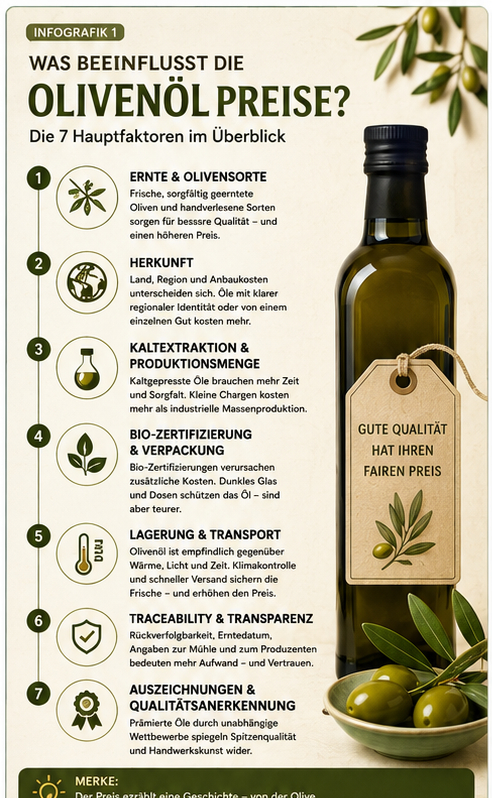
Several factors shape olive oil prices. Together, they explain why one bottle can cost three times as much as the one next to it.
1.1 Harvest and Olive Variety
Fresh, carefully picked olives usually make better oil. As a result, that quality shows up in the price. Almost any olive variety can produce excellent oil when it’s grown and pressed with care. Variety mostly shapes the flavor profile, not the price tag. For more detail, see our olive varieties and agriculture page.
1.2 Country of Origin
Labor, land, and production costs differ by country. So origin plays a real role in olive oil prices. Oils with a clear regional identity cost more. The same goes for oil from a single estate, like our olive grove in Tunisia. By contrast, blended supermarket oils usually cost less.
1.3 Cold Extraction and Production Scale
Cold-pressed oils take more care to make. That care preserves aroma and quality. However, it also raises the cost. Large-scale industrial production works the other way: it keeps prices low. Meanwhile, small-batch oil almost always costs more. Simply put, it’s harder to make well. See our olive oil production page for more on this.
1.4 Organic Certification and Packaging
Organic olive oil tends to cost more. That’s because certification adds extra costs. For instance, the EU Organic and Demeter certifications require yearly farm inspections. This is one reason certified oil isn’t cheap to produce. Packaging matters too. Dark glass and tins protect the oil from light. But they also cost more than clear bottles.
1.5 Storage and Transport
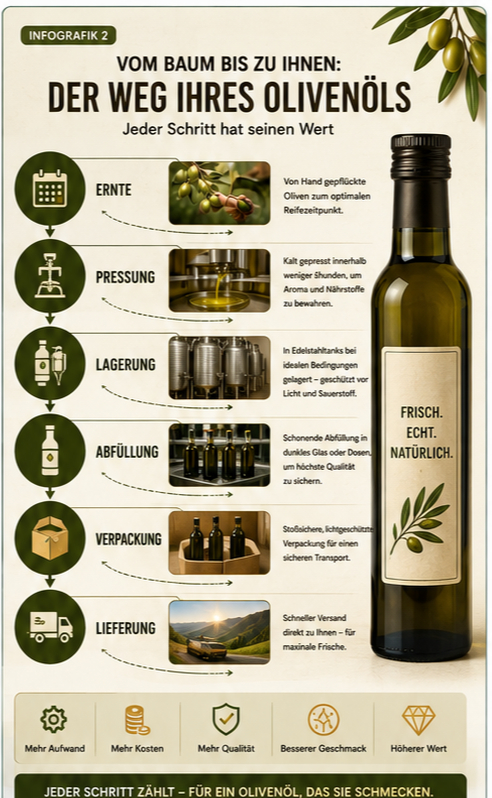
Olive oil is sensitive to heat, light, and time, so it needs climate-controlled storage and fast shipping to stay fresh, and that extra handling adds to the price. Producers who ship directly to the customer, without long warehouse stays, can charge more for that freshness even though the route is shorter.
2. Average Olive Oil Prices by Category
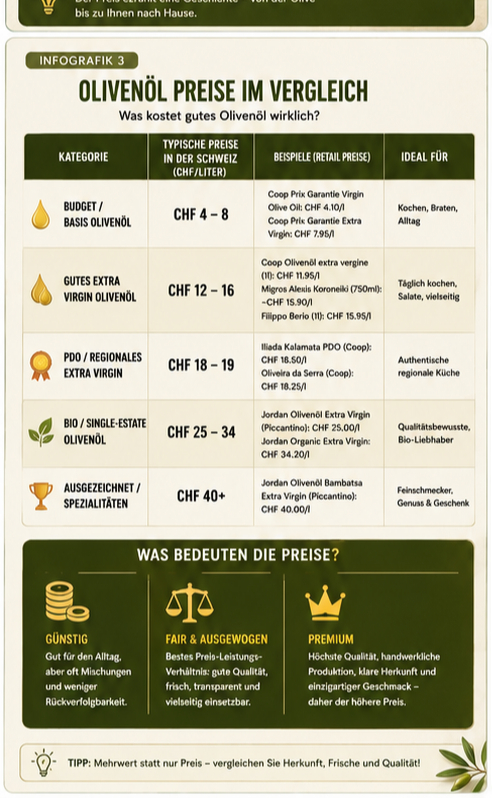
The table below uses real, current shelf prices from Swiss retailers (Coop, Migros, and specialty importer Piccantino), converted to price per liter. These are actual examples, not estimates — use them as a starting point, since individual bottles and promotions vary.
| Olive oil type | Typical price in Switzerland | Real example |
| Budget / basic olive oil | 4–8 CHF/liter | Coop Prix Garantie Virgin Olive Oil: 4.10 CHF/L Coop Prix Garantie Extra Virgin: 7.95 CHF/L |
| Good extra virgin olive oil | 12–16 CHF/liter | Coop Olivenöl extra vergine (1l): 11.95 CHF/L Migros Alexis Koroneiki (750ml): ~15.90 CHF/L Filippo Berio (1l): 15.95 CHF/L |
| PDO / regional extra virgin | 18–19 CHF/liter | Iliada Kalamata PDO (Coop): 18.50 CHF/L Oliveira da Serra (Coop): 18.25 CHF/L |
| Organic / single-estate | 25–34 CHF/liter | Jordan Olivenöl Extra Virgin (Piccantino): 25.00 CHF/L Jordan Olivenöl Organic Extra Virgin: 34.20 CHF/L |
| Award-winning / specialty | 40+ CHF/liter | Jordan Olivenöl Bambatsa Extra Virgin (Piccantino): 40.00CHF/L |
3. Is Expensive Olive Oil Always Better?
Not necessarily. A higher price can be fair. That’s true for a recent harvest, a respected producer, or a small lot with great flavor. But sometimes the price is mostly branding. In other words, it doesn’t always reflect what’s in the bottle. In fact, some supermarket oils do well in blind taste tests. So a high price tag doesn’t always mean better quality.
When a higher price makes sense:
- The oil has a clear harvest date
- The origin is transparent
- The oil is cold extracted and freshly bottled
- The producer explains the variety and process
- The taste is complex: fruity, bitter, and peppery
When the price is mostly branding:
- The label is vague
- The bottle looks premium but gives little product information
- No harvest date is shown
- The oil is a generic blend with weak traceability
4. How to Buy Good Olive Oil at a Fair Price
Compare olive oil prices by label, origin, and freshness. In short, don’t compare by price alone. Not sure where to start? Then try our olive oil finder. Or compare our products side by side.
4.1 Labels Worth Checking
- Extra virgin, clearly stated. This is a legal grade set by the International Olive Council. It’s not just a marketing term.
- Harvest date or harvest year
- Clear origin or single-estate sourcing
- Cold extraction or mechanical extraction wording
- Dark glass or protective packaging
4.2 Certifications That Matter
- Organic certification, if you value organic farming standards
- PDO/PGI, if you want regional traceability protected by law
- Trusted producer information, ideally with a named mill or estate. For example, read who we are and how we produce our oil.
What matters most in practice? Freshness beats fancy packaging. Similarly, traceability beats vague marketing. Overall, a recent harvest matters more than a big brand name. And taste matters more than a high price tag.
4.3 Common Olive Oil Pricing Myths
Myth 1: Expensive always means better. Not true. In fact, some mid-priced oils score very well. They offer great value.
Myth 2: Cheap olive oil is always bad. Also not true. Basic supermarket olive oil can work well for everyday cooking, especially if you don’t need a premium flavor profile. However, make sure the bottle is labeled “extra virgin” at a minimum. Extra virgin olive oil is the highest quality grade and offers better flavor and stricter quality standards. In contrast, “virgin” olive oil is a lower grade that may have minor taste defects or fail to meet some of the chemical standards required for extra virgin classification.
Myth 3: Organic automatically means top quality. Not quite. Organic may be the better farming choice. But it doesn’t guarantee better taste on its own.
4.4 Expert Buying Tips
Is your budget tight? Then pick a reliable extra virgin oil with a clear origin and a recent harvest. Use it for everyday cooking. Want the best flavor instead? Then spend more on a single-estate or award-winning bottle. Save it for salads and dipping bread.
Budget-based recommendations:
- Budget buyer: a good supermarket extra virgin oil in the €5–€9 range
- Balanced buyer: a strong price-to-quality ratio in the €9–€15 range. For example, our Classic or Yara oils
- Quality-focused buyer: organic or single-estate oil around €15–€25, such as our Heritage Demeter-certified oil
- Food lover: award-winning oils above €20, such as our Polyphena high-polyphenol oil
5. Conclusion
Fair olive oil prices aren’t about the cheapest bottle. Nor are they about the priciest one. Instead, it’s about matching quality and freshness to your budget. So compare olive oil prices by quality level. Don’t just look at the sticker price. That way, you skip low-value buys. Plus, you get oil that actually tastes good. In the end, fair pricing comes down to freshness and careful production, not just marketing.
Ready to taste the difference? Then shop the full Iline Organic collection. It’s grown in our own groves in Tunisia. Every bottle ships fresh, with the origin, variety, and harvest details included.
6. FAQ
What does good olive oil cost per liter? A good extra virgin olive oil typically costs €9–€15 per liter in the EU, or roughly CHF 10–16 in Switzerland. Organic and single-estate oils run higher, from about €10 to €25 per liter, and award-winning bottles can pass €40.
Why is high-quality olive oil so expensive? It costs more due to careful harvesting and cold extraction. Better packaging, transport, and traceable sourcing add to that.
Is cheap olive oil worse? Not always. Some low-cost oils are fine for everyday cooking. Still, check quality and freshness first.
How do I recognize a good price-to-quality ratio? Look for a clear harvest date and transparent origin. The packaging and price should match the oil’s freshness level.
Is organic olive oil worth it? Yes, if you value organic farming and certification. That said, it isn’t automatically the best-tasting oil.
How much should you pay for extra virgin olive oil? A fair price depends on origin and quality level. Good extra virgin oil costs more than the cheapest supermarket range. And higher prices make sense when the oil is fresher or award-winning. Yes. Direct purchase usually means better freshness and better traceability. It also tends to mean fairer pricing and stronger support for family farms.

Downloads
Video summary